The Republican Party of Florida holds an advantage in overall voter registration and may benefit from congressional maps drawn in its favor, but those factors do not guarantee victory. In competitive races, the real battleground is often not the partisan registration gap itself, but who actually turns out to vote — especially among voters who are not registered with either major party.
Elections are decided by the voters who actually show up — and by how independent, no-party-affiliation, and minor-party voters break on Election Day.
Florida voters who are not registered as Republicans or Democrats do not make up a majority of the electorate. However, they still represent a large and potentially decisive bloc. As of April 30, 2026, Florida had about 3.8 million voters registered as having no party affiliation or as members of minor parties.
That means Democrats do not necessarily need to erase the Republican registration advantage to win statewide races such as governor or U.S. senator. They would need a favorable combination of stronger Democratic turnout, weaker Republican turnout and a major shift among independent and minor-party voters.
Florida’s Current Statewide Registration Breakdown
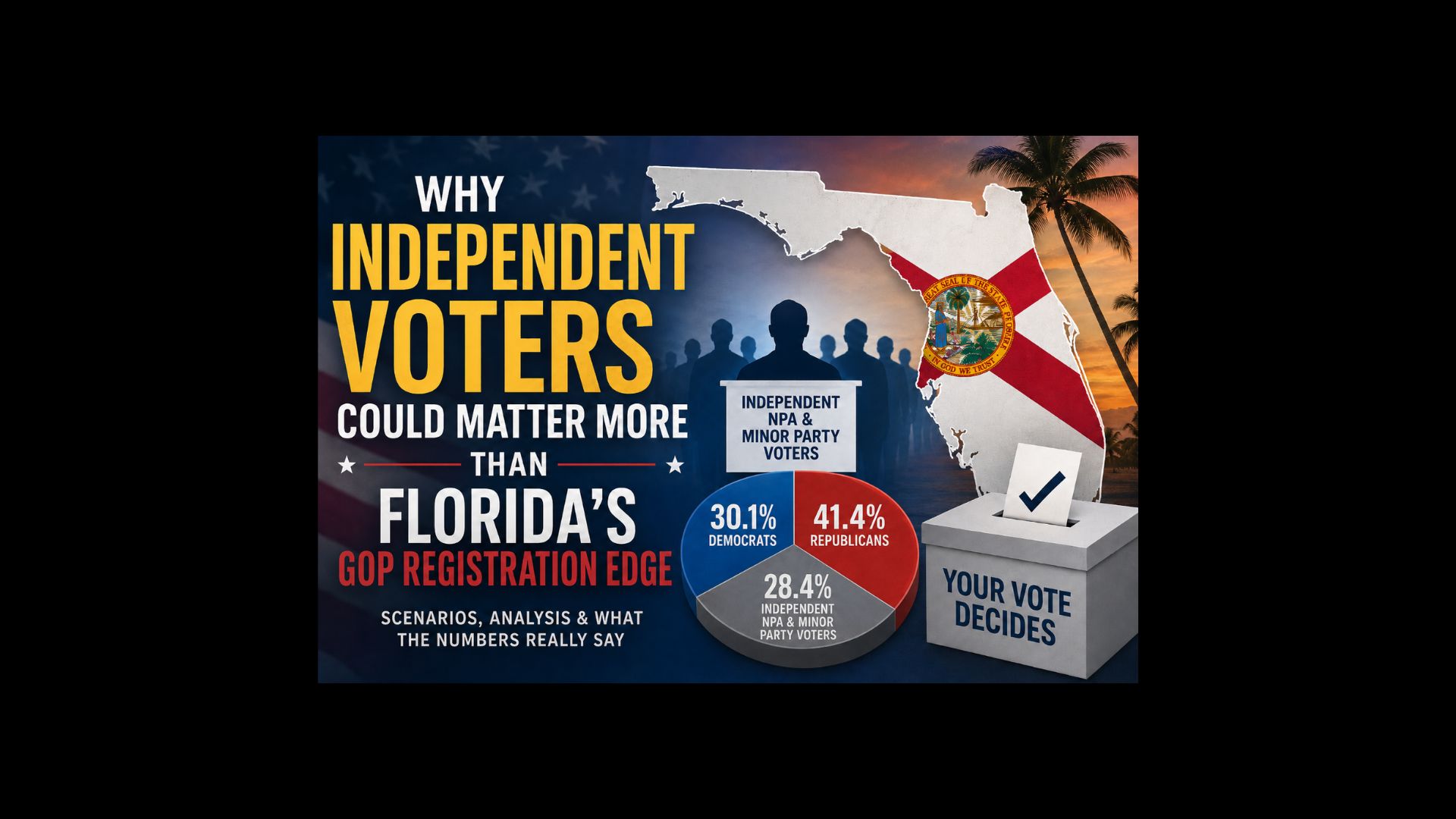
Entering this month, Florida had approximately 5.53 million registered Republicans, 4.03 million registered Democrats, and 3.8 million voters who were not registered with either major party.
Those non-Republican and non-Democratic voters include 3.32 million no-party-affiliation voters and about 481,000 minor-party voters. Combined, they represent about 28.4% of Florida’s active registered voters.

While Republicans and Democrats still make up the majority of the electorate, the independent and minor-party bloc is large enough to influence close statewide elections — especially if turnout changes from one election cycle to the next.
Why The Independent Vote Can Change The Math
A Republican registration edge gives GOP candidates a clear starting advantage, but it does not guarantee victory. If Republican turnout drops, if Democratic turnout improves, or if moderate independent voters shift away from Republican candidates, the advantage can narrow quickly.

Many independent and no-party-affiliation voters are not rigidly ideological. Some lean consistently conservative or liberal, but others are more moderate and may move from one election to the next depending on candidate quality, the economy, abortion, immigration, crime, affordability, national mood or dissatisfaction with the party in power.
That is why Democrats could still win statewide races even without overtaking Republicans in registration. The path would likely require Democrats to hold or improve their own turnout while winning a large share of the voters outside the two major parties — especially if Republican enthusiasm softens at the same time.

Scenario 1: Republican Turnout Drops 5%, Other Turnout Patterns Stay Similar To 2022

In this model, Republican turnout falls by 5% compared to the estimated 2022 baseline. Democratic turnout stays roughly the same, while independent, NPA and minor-party turnout also remains close to 2022 levels.
Under that scenario, Democrats would need about 1.35 million votes from non-Republican and non-Democratic voters. That would equal roughly 75% of the non-R/D voters who actually turn out, or about 35.4% of all currently registered non-R/D voters.
Scenario 2: GOP Turnout Drops 5%, Democratic Turnout Rises 5%, Non-R/D Turnout Rises 5%

This second model is more favorable to Democrats. It assumes Republican turnout drops by 5%, Democratic turnout increases by 5%, and turnout among independent, NPA, and minor-party voters also rises by 5% compared to the 2022 baseline.
Under this scenario, Democrats would need about 1.33 million votes from the NPA/minor-party bloc to narrowly win statewide. That equals roughly 70.7% of the non-R/D voters who turn out, or about 35.0% of all currently registered non-R/D voters.
This is a better path for Democrats than the first scenario, but it still requires a very large advantage among independent and minor-party voters.
Could Republicans Still Lose If They Win A Large Share Of Independents?
Under the first model, probably not. If Republicans won more than 35% of all currently registered NPA and minor-party voters, that would amount to more than 1.33 million votes from that bloc. If total non-R/D turnout remained around 2022 levels, Democrats would not have enough remaining independent and minor-party votes to reach the number needed to win.
The key distinction is that 35% of all registered independent and minor-party voters is not the same thing as 35% of those voters who actually turn out. Because many registered voters sit out midterm elections, winning 35% of the entire non-R/D registration pool would represent a very large share of the non-R/D voters who cast ballots.
Plain-English Takeaway: This scenario improves the Democratic path, but Democrats would still need to win roughly seven out of every ten independent, NPA, and minor-party voters who turn out.
Scenario 3: GOP Turnout Stays Near 2022 Levels, Democratic Turnout Rises 5%, Non-R/D Turnout Rises 5%

This third scenario is tougher for Democrats than Scenario 2 because Republican turnout does not decline. Instead, GOP turnout remains close to the estimated 2022 baseline, while Democratic turnout rises by 5% and turnout among independent, NPA and minor-party voters also rises by 5%.
Under this model, Democrats would need about 1.42 million votes from the non-Republican/non-Democratic voter bloc to narrowly win statewide. That equals roughly 75.4% of the non-R/D voters who turn out, or about 37.3% of all currently registered non-R/D voters.
The plain-English takeaway is that higher Democratic turnout helps, but if Republican turnout remains strong, Democrats would still need an overwhelming advantage among independent, NPA and minor-party voters. In other words, Democrats could improve their own turnout and still fall short unless the independent vote breaks heavily in their favor.
This fourth scenario yields a stronger improvement in turnout than Scenario 3. Republican turnout remains close to the estimated 2022 baseline, but Democratic turnout rises by 10%. Turnout among independent, NPA, and minor-party voters also rises by 10%.
Under this model, Democrats would need about 1.40 million votes from the non-Republican/non-Democratic voter bloc to narrowly win statewide. That equals roughly 71.1% of the non-R/D voters who turn out, or about 36.9% of all currently registered non-R/D voters.
The plain-English takeaway is that a 10% increase in Democratic turnout would improve the Democratic path, but it would not eliminate the need for a major advantage among independent voters. If Republican turnout remains near 2022 levels, Democrats would still need to win more than seven out of every ten independent, NPA and minor-party voters who cast ballots.
Florida’s Republican registration advantage is real, and it gives GOP candidates a major head start. But the outcome of statewide races still depends heavily on turnout and persuasion. A Republican-leaning electorate can become more competitive if GOP turnout softens, Democratic turnout improves and moderate independent voters shift toward Democratic candidates.
For Democrats, the challenge is steep: they would likely need a combination of higher Democratic enthusiasm and a strong showing among independents. For Republicans, the warning sign is clear: registration advantages and favorable maps are not enough if their voters stay home and the independent vote moves sharply against them.
Scenario 4: GOP Turnout Stays Near 2022 Levels, Democratic Turnout Rises 10%, Non-R/D Turnout Rises 10%

This fourth scenario yields a stronger improvement in turnout for Democrats than Scenario 3. Republican turnout remains close to the estimated 2022 baseline, but Democratic turnout rises by 10%. Turnout among independent, NPA and minor-party voters also rises by 10%.
Under this model, Democrats would need about 1.40 million votes from the non-Republican/non-Democratic voter bloc to narrowly win statewide. That equals roughly 71.1% of the non-R/D voters who turn out, or about 36.9% of all currently registered non-R/D voters.
The plain-English takeaway is that a 10% increase in Democratic turnout would improve the Democratic path, but it would not eliminate the need for a major independent-voter advantage. If Republican turnout remains near 2022 levels, Democrats would still need to win more than seven out of every ten independent, NPA and minor-party voters who cast ballots.
Methodology Note
These scenarios are simplified models based on Florida voter-registration totals and estimated 2022 turnout patterns. They are not predictions. Actual election outcomes would also depend on candidate quality, campaign spending, the national political environment, issue salience, vote-by-mail behavior, regional turnout differences and crossover voting by registered partisans.
RELATED CONTENT: