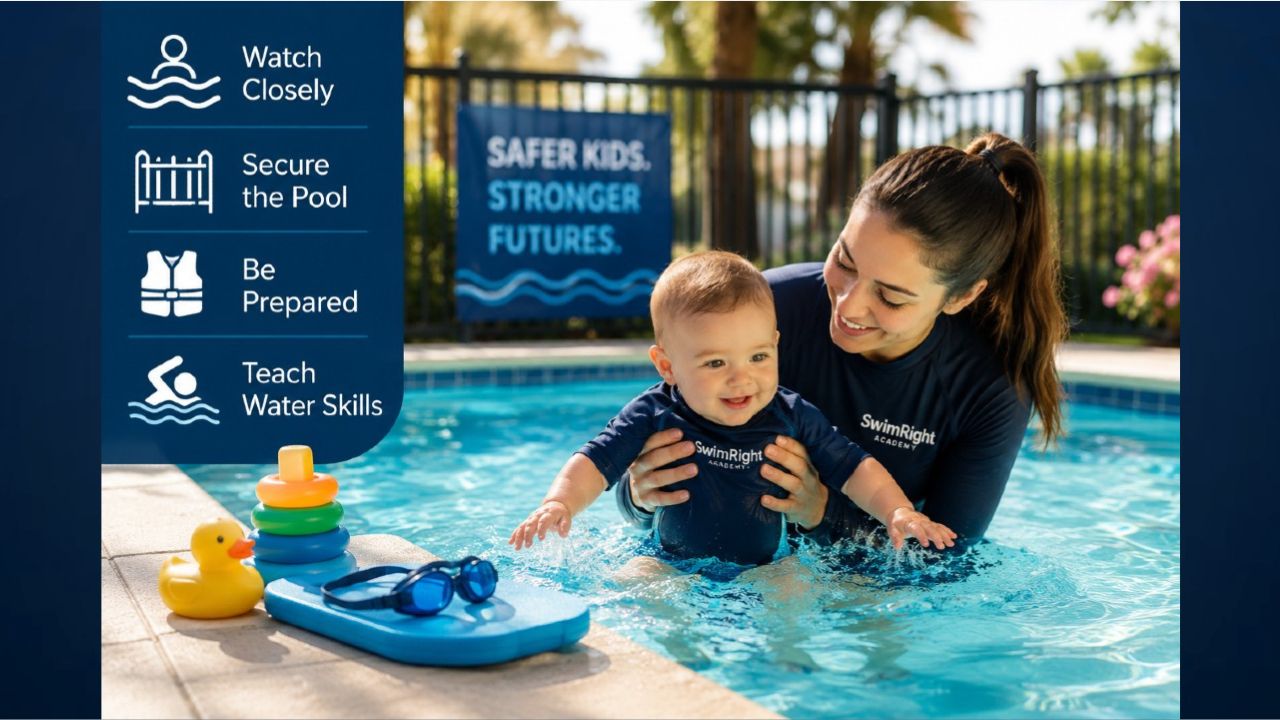
For Florida families, water is part of everyday life. Backyard pools, community pools, beaches, lakes and other waterways provide opportunities for recreation throughout much of the year. They also mean that parents need to think about water safety well beyond the summer months.
The Florida Department of Health reports that drowning is the leading cause of unintentional death among children ages 1 to 4 in Florida. In 2023 alone, more than 500 Floridians died from unintentional drowning.
For parents, these numbers point to a practical question: What can families do to reduce risks around water?
There is no single answer. Effective drowning prevention involves several layers of protection, including active supervision, physical barriers, emergency preparedness and age-appropriate swimming instruction.
Active Supervision Comes First
Swimming lessons are valuable, but they do not replace adult supervision.
Young children should never be left alone in or near water, even if they have had swimming instruction or are wearing a flotation device. The Florida Department of Health emphasizes that drowning can happen quickly and silently, including during a short distraction.

Parents can make supervision more effective by giving the child their full attention rather than relying on phones, conversations or other activities. When several adults are present, families can also designate a specific person to act as the Water Watcher.
For infants and toddlers, staying close enough to provide immediate physical assistance is particularly important.

Barriers Can Prevent Unplanned Access to Water
A child does not have to be swimming for a drowning risk to exist.
A toddler who wanders away from an adult can reach a backyard pool, spa, pond or other source of water within moments. This is why physical barriers are another important layer of protection.
The Florida Department of Health recommends multiple barriers where appropriate and notes that home swimming pools are a major setting for childhood drowning.
Pool fencing, self-closing and self-latching gates, secure doors and other protective measures can make it harder for a child to reach the water without an adult.
Parents should also remember that infants can be at risk around very small amounts of water. According to the Florida Department of Health, most infant drownings occur in just a few inches of water, including bathtubs and buckets.
Where Do Swimming Lessons Fit In?
Swimming instruction represents another layer of water safety.
The purpose of lessons for young children is not to make them “drown-proof.” No swimming program can remove the need for supervision or eliminate every risk around water.
Instead, age-appropriate instruction can give children opportunities to become more comfortable in the water and gradually develop foundational aquatic skills.
For older children, formal swimming instruction may include body position, propulsion, breathing, floating, entries and exits and progressively more independent swimming.
For babies and toddlers, the approach is different.

Early classes may focus on helping a child become comfortable with water while teaching parents how to support the child safely. The parent can remain physically involved while an instructor demonstrates appropriate techniques and activities.
Why Parent-and-Baby Classes Can Be Useful
An infant does not need to swim laps to benefit from structured time in the water.
Parent-and-baby classes can introduce simple experiences such as supported floating, controlled movement through the water and gradual exposure to different positions.
They can also help parents become more confident about how to handle their child in a pool.
This parent involvement is particularly useful for families who are new to organized swim instruction. Rather than placing a young child in the water alone, the parent participates alongside the instructor and receives guidance throughout the session.
A structured class can also provide a consistent routine. Songs, games and repeated activities can make the environment more familiar to a young child while introducing basic aquatic concepts.
In Miami, SwimRight Academy offers a Swim-Tot program for children under 2, with parents or guardians participating in the water. The program introduces water comfort, supported underwater experiences and back-float work through songs and games.
One example is the SwimTots program in Miami, where a parent or guardian participates in the water while an instructor introduces basic aquatic skills.
What Should Parents Look for in an Infant Swim Program?
Choosing a class for a baby or toddler requires a different set of considerations than choosing lessons for an older child.
Parents may want to ask:
- Is the parent or caregiver expected to participate in the water?
- How does the instructor introduce new skills?
- Are activities appropriate for the child’s age and ability?
- How does the program respond when a child becomes uncomfortable?
- Are classes short enough for an infant’s attention span?
- What role does water safety play in the instruction?
- Are instructors appropriately trained?
The Florida Department of Health’s Swimming Lesson Voucher Program requires participating instructors to have certification through organizations such as the American Red Cross or YMCA, current first-aid and CPR certification, and the required background screening.
Those requirements apply specifically to instructors participating in the state’s voucher program, but they also illustrate the types of qualifications parents can ask about when evaluating a swim program.
Swimming Lessons Are Not a Substitute for Supervision
One of the most important messages for parents is also one of the simplest: swimming ability does not remove the need for supervision.
A child may be comfortable in a pool but still encounter very different conditions at a beach, lake, canal or other natural body of water.
Florida’s Department of Health notes that children ages 1 to 4 are most likely to drown in home swimming pools, while older children are more likely to face risks in natural bodies of water.
Water conditions can also change. Currents, waves, depth, visibility, weather and the presence of other swimmers can all affect a child’s ability to respond safely.
For that reason, parents should treat swimming instruction as one component of a broader safety plan.
Families Can Build Multiple Layers of Protection
A strong family water-safety plan does not depend on a single precaution.
Parents can combine:
Active supervision: Keep a close eye on children whenever they are in or near water.
Physical barriers: Use appropriate fencing, gates, alarms and secure access points around pools and other water sources.
Swimming instruction: Give children opportunities to develop age-appropriate aquatic skills through qualified instruction.
Emergency preparedness: Keep a phone accessible, know how to contact emergency services and consider obtaining CPR training.
Clear family rules: Teach children that they should never enter a pool or approach other bodies of water without permission from an adult.
Each layer addresses a different part of the risk. If one layer fails, another may provide additional protection.
Florida Families Have More Than One Resource
Florida has also taken steps to make swimming instruction more accessible to some families.
The state’s Swimming Lesson Voucher Program was established to provide free swimming lessons to eligible Florida families. The current application cycle closed on March 20, 2026, and the Florida Department of Health advises families to check for information about future application periods and available resources.
The program reflects a broader recognition that access to swimming instruction can be part of a statewide approach to water safety.
For parents, however, water safety starts long before a child enters a formal class. It begins with supervision, secure barriers and clear family habits around water.
Swimming instruction can then become another part of that system, helping children develop skills and helping parents become more familiar with safe ways to support their children in the water.
Start With Age-Appropriate Skills
Parents do not need to rush a baby into advanced swimming techniques.
For the youngest children, the first goals can be simple: becoming comfortable in the water, experiencing supported movement, responding to familiar cues and developing positive associations with the pool.
As children grow, instruction can progress toward more independent skills.
The most important point is that every child develops differently. Parents should choose activities that match the child’s age, comfort level and abilities rather than comparing one child’s progress with another’s.
Florida families have many opportunities to enjoy the water. With active supervision, appropriate barriers, emergency preparation and age-appropriate swimming instruction, parents can add several layers of protection while helping children build skills they can carry into later childhood.