
Every single day, we face a continuous stream of choices that require us to weigh potential dangers against future benefits. Whether you are deciding to change careers, purchase a new vehicle, or simply try out a new restaurant down the street, your brain acts as a quiet calculator. Industry metrics from behavioral psychology reports reveal that the average adult makes over 35,000 choices every 24 hours. While many of these actions are automatic, the larger, life-altering decisions require a more systematic approach to avoid unnecessary setbacks. By understanding how to properly balance your odds, you can take control of your path and make choices with total confidence.
The Strategic Methods Behind Every Smart Gamble in Life
Reviewing how people analyze probabilities on popular regional platforms like online casinos in Florida provides an excellent look at human decision-making under uncertainty. When individuals engage with digital spaces that offer fluid, unpredictable outcomes, they must constantly balance their current assets against potential long-term rewards. This process mirrors the exact same mental framework needed when deciding to invest in a new business venture or move to an unfamiliar city. Choosing to take a calculated chance requires you to establish rigid boundaries, study the underlying math, and accept that some elements will always remain entirely out of your control. Embracing this analytical mindset helps remove the raw emotion from stressful situations so you can focus strictly on logic.
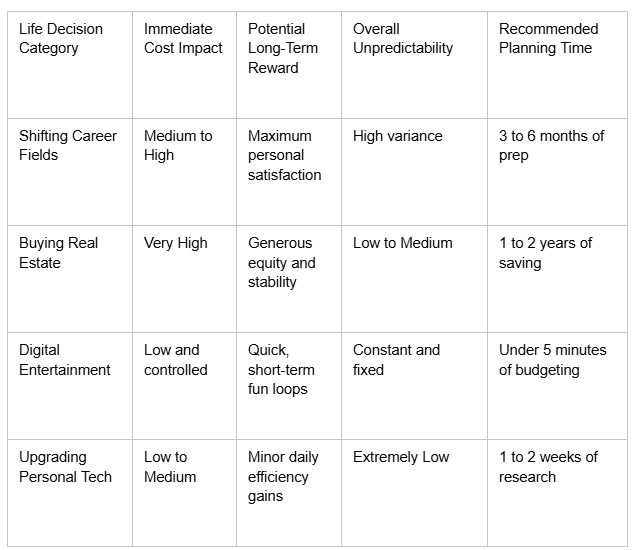
Data tracking from national gaming associations shows that consumers who approach chance-based entertainment with a strict plan experience far less financial strain than impulsive decision-makers. This shows that treating uncertain situations as mathematical formulas rather than emotional rollercoasters leads to much better outcomes. To see how different common life choices fit into a basic risk-benefit matrix, review the data framework outlined below.

Simple Mental Models to Simplify Complex Choices
You do not need an advanced degree in mathematics to start making more logical choices in your everyday routine. Using a few established structural frameworks can instantly clear away the mental fog that often leads to decision paralysis.
Practical Frameworks for Better Choices
- The Worst-Case Scenario Test: Always ask yourself if you can easily survive the absolute lowest outcome before moving forward.
- The 10-10-10 Rule: Consider how your current choice will affect your life in ten minutes, ten months, and ten years down the line.
- The Regret Minimization Framework: Project yourself into the future and select the path that actively reduces your long-term feelings of missing out.
Adopting these basic filters prevents your brain from making impulsive mistakes driven by temporary fear or excitement. It gives you a clean, repeatable strategy for handling tricky personal crossroads.
Recognizing the Trap of the Sunk Cost Fallacy
A major hurdle in personal growth is our natural tendency to stick with a losing plan simply because we have already invested time or money into it. Recognizing this cognitive bias is crucial for protecting your future assets.

Fast Steps to Walk Away from Bad Choices
- Ignore historical expenses: Focus entirely on what a project will cost you moving forward rather than what you spent in the past.
- Seek outside perspective: Ask a neutral friend to review your situation without any emotional attachment to the original goal.
- Accept minor losses early: Cutting a failing project loose immediately saves you from experiencing a much bigger disaster later.
Shifting your focus toward future potential rather than past investments keeps your path clear of old baggage. It ensures your energy goes toward projects that offer a genuine return on your time.
Mastering Your Personal Odds for Future Success
Navigating life successfully does not mean avoiding all danger, but rather learning how to choose the right moments to take a step forward. Implementing simple mental models, setting clear boundaries for your budget, and learning to walk away from failing plans keeps your trajectory moving in the right direction. When you treat life’s big questions as a series of calculated choices, you can pursue your biggest goals with total clarity and peace of mind.