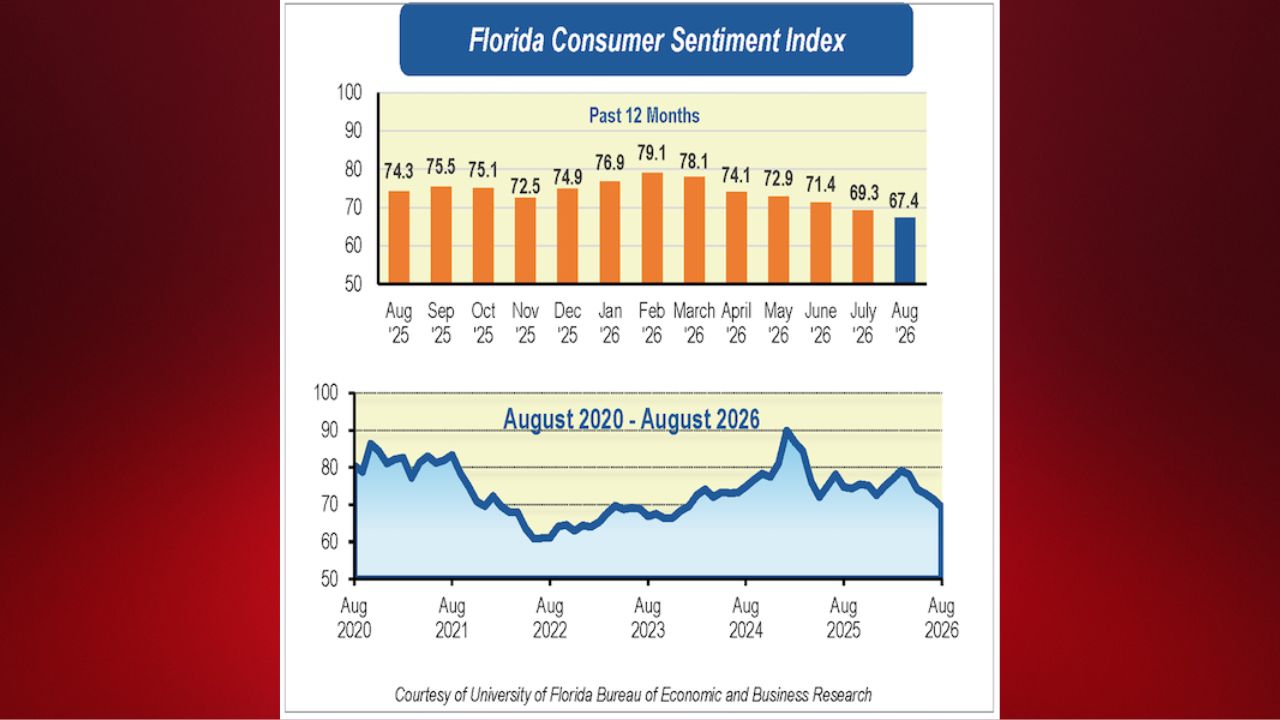
A report from the University of Florida (UF) revealed that consumer sentiment continued its downward trend in August across the Sunshine State. According to UF, Florida consumer sentiment declined for the sixth consecutive month to 67.4, down 1.9 points from a revised July reading of 69.3. Similarly, national consumer sentiment decreased.
Hector H. Sandoval, director of the Economic Analysis Program at UF’s Bureau of Economic and Business Research, noted that August marked the second consecutive month in which all five components of the index of the consumer sentiment index declined, which he described as a relatively uncommon occurrence
Expectations for U.S. economic conditions over the next year showed the steepest drop, falling 3.1 points from 68.5 to 65.4. Expectations for U.S. economic conditions over the next five years decreased 2.6 points from 72.2 to 69.6.
“Consumer sentiment deteriorated further in August, driven primarily by Floridians’ expectations for the national economy, particularly in the short run, ” Sandoval said. In fact, views about the country’s economic outlook over the next 12 months have declined consistently over the past six months, falling nearly 17 points and reaching their lowest level since November 2023. This growing pessimism is consistent with an economic environment that remains challenging for consumers. Although inflation and gasoline prices have moderated recently, both remain elevated. At the same time, labor market conditions have softened over the past year, although recent developments in Florida’s labor market point to some stabilization. Combined with continued geopolitical uncertainty and recent trade policy changes, these conditions help explain why consumer sentiment has remained on a downward trajectory.”
Conducted July 1 to Aug. 27, the UF study reflects the responses of 358 individuals who were reached on cellphones representing a demographic cross section of Florida.
Data are weighted based on Florida county of residence, age group, and sex to ensure representativeness of the Florida population. The population figures used for weighting (targets) are obtained from the Population Program of the Bureau of Economic and Business Research (BEBR), which produces the official population estimates for the state of Florida. Phone data quality is maintained by monitoring and reviewing interviews and prevention of duplicate records.
The index used by UF researchers is benchmarked to 1966, which means a value of 100 represents the same level of confidence for that year. The lowest index possible is 2, and the highest is 150.
Details of this month’s survey can be found at bebr.ufl.edu/florida-consumer-sentiment/.