Guest op-ed by Skylar Zander
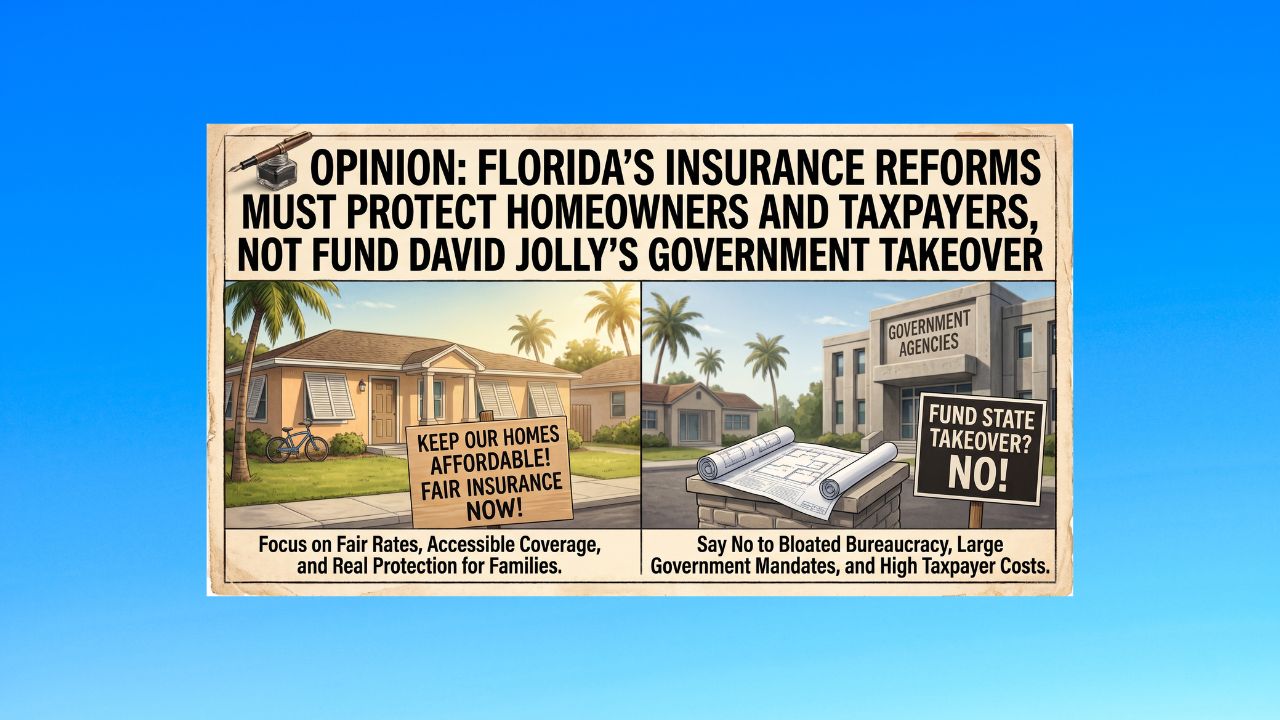
Florida families continue to face real affordability pressure when it comes to property insurance. Homeowners want lower premiums, more choices, and confidence that their insurer will be there when they need help. Policymakers should keep looking for ways to deliver meaningful relief. But affordability cannot be achieved simply by moving costs around, and Florida should be wary of proposals that replace private-market risk with greater government exposure, like the one Democratic gubernatorial candidate David Jolly is now selling to voters.
Jolly’s pitch sounds simple: create a state catastrophic fund, strip hurricane and natural disaster coverage out of the private market entirely, and let government absorb the risk instead. He claims it could cut private premiums by roughly 60 percent. What he doesn’t emphasize is that the underlying risk doesn’t disappear when the government assumes it. It simply becomes concentrated within a public system, raising an unavoidable question Jolly hasn’t answered: who pays when losses exceed the resources available?
Florida already has a public backstop through the Florida Hurricane Catastrophe Fund. The Cat Fund provides participating insurers with a layer of reinsurance and helps ensure claims-paying resources are available when needed. But it was designed to function alongside a private insurance market, not to replace one, which is precisely the distinction Jolly’s plan erases.
If its available resources are insufficient, the Cat Fund can issue post-event revenue bonds, repaid through emergency assessments on most property and casualty insurance premiums in Florida. Costs that aren’t accounted for up front don’t vanish. They reappear later through borrowing and assessments that hit Florida consumers, the same consumers Jolly promises to save money.

California offers a cautionary example of how catastrophe costs can migrate through an insurance system after disaster strikes. As private insurers pulled back from wildfire-prone areas, enrollment in the state’s FAIR Plan, the insurer of last resort for property owners unable to obtain coverage in the voluntary market, surged. Then the January 2025 Palisades and Eaton fires left the plan facing roughly $4 billion in incurred losses, prompting regulators to approve a $1 billion assessment on participating insurers to provide additional claims-paying resources.
Insurers were subsequently allowed to recover half of that assessment from policyholders through approved temporary fees.

California’s experience demonstrates the central financing issue with catastrophe backstops: losses that exceed resources available before a disaster still have to be financed afterward. Whether that takes the form of assessments, supplemental charges, borrowing, or some combination of them, shifting catastrophe risk into a concentrated backstop changes how the bill is paid, not the underlying cost of the disaster.
Jolly’s own team has floated new taxes on real estate transactions or diverting tourism revenue to make the numbers work. That’s not a savings plan. That’s a bill that gets paid one way or another, just moved off the insurance statement and onto Floridians in a different form.

Nationalizing hurricane risk under a single government fund doesn’t eliminate financial risk, it just changes where that risk sits, and hands the state the kind of centralized control over an entire market that has failed everywhere it’s been tried. The more exposure concentrated in a public entity, the more important its reserves, borrowing capacity, and assessment authority become. Floridians deserve to understand that tradeoff before Jolly’s plan ever reaches their ballot, not after.
There’s a broader market consequence too. A healthy insurance market depends on competition among financially sound insurers, access to private capital, accurate pricing of risk, and meaningful choices for consumers. Jolly’s proposal to strip an entire line of risk out of the private market and hand it to a government fund would gut all four, distorting market signals, driving private capital out of the state, and moving Florida’s insurance system toward a socialized, government-run model more reminiscent of failed European welfare-state economics than a free Florida market.
Florida should be moving in the opposite direction. The state’s Office of Insurance Regulation reported in May that 20 insurers had entered Florida’s property market since recent legislative reforms, proof that competition, not government takeover, is what actually brings relief. More insurers competing for customers expands consumer choice and brings additional private capital into the market. Florida should build on that progress by encouraging competition, maintaining appropriate solvency standards, and removing unnecessary barriers that make it harder for financially sound insurers to serve Florida families. Jolly’s plan would undo that progress in one stroke, chasing private insurers out just as they’re finally coming back in.
Florida has made important reforms to stabilize its insurance market, and state regulators have reported signs of increased competition and improving rate activity. Policymakers should protect that progress by pursuing more competition, more consumer choice, and greater participation from private capital, not by adopting David Jolly’s, misguided socialist take over of Florida’s private insurance market.
There are no shortcuts around Florida’s hurricane risk. Lasting insurance reform should make the market more competitive and resilient while ensuring Floridians understand who ultimately bears the cost when disaster strikes. Jolly’s plan asks Floridians to trust government bureaucracy. Florida’s homeowners deserve better than a bet that big.
The right time to answer those questions is before Jolly’s proposal becomes law, not after the bill comes due.
Skylar Zander is the State Director of Americans for Prosperity-Florida.