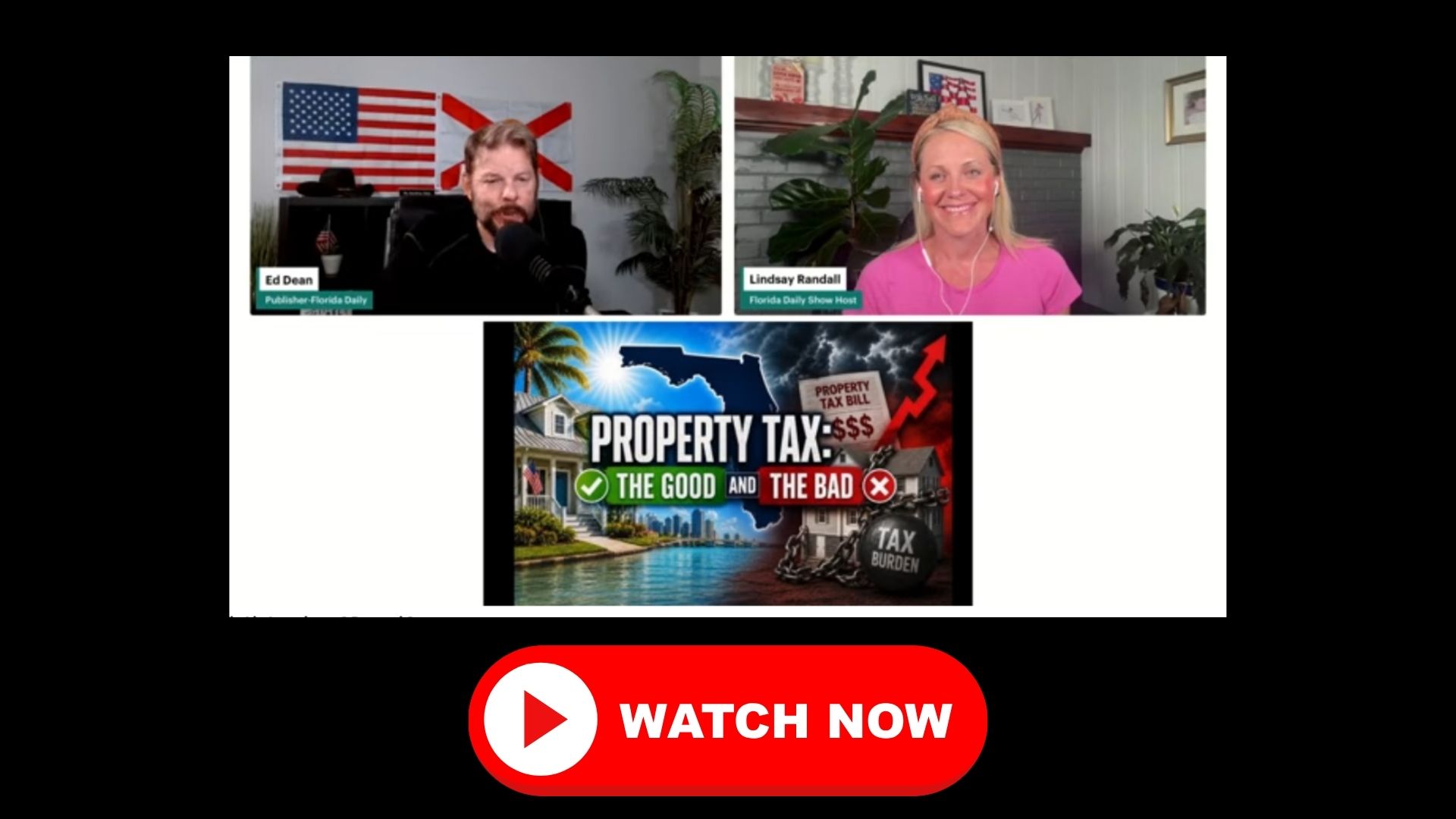
Florida Amendment 3: A closer look at property tax relief, government spending, and voter support. Florida Daily Show hosts Ed Dean and Lindsay Randall discuss the potential benefits and drawbacks of Florida’s Amendment 3 property tax proposal, including concerns about local government spending, higher taxes and fees, and whether the measure can secure enough voter support to pass.
Below is the transcript.
Ed Dean:
Let me tell you something. I’ve said this a thousand times, and Lindsay knows where I stand on this issue.
I recently got drawn into a Facebook discussion. One of our good friends posted a question about Amendment 3. If I told you who she was, everybody would know her.
She was genuinely asking, “I’m a little perplexed. Where should I stand on Amendment 3? Should I vote yes or no?”
Of course, a lot of my friends immediately responded, “Amendment 3 all the way!”
And I’m thinking, here we go again. They haven’t read the proposal. They haven’t read the amendment.
I went back and reread it myself. People keep saying it’s going to starve government, but there’s nowhere in this amendment that actually forces local governments to cut spending.
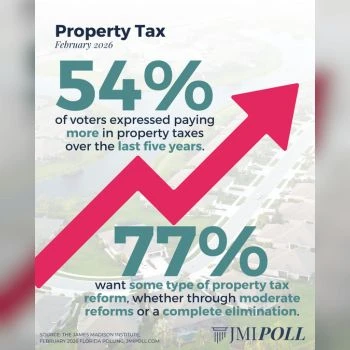
I’m with the James Madison Institute on this. We need a levy cap or something else that controls government spending.
I guarantee you that many of the people supporting this amendment haven’t gone to their local city councils or county commissions demanding spending cuts or property tax rate reductions. Yet they want Tallahassee to solve the problem.
We’re not talking about controlling spending, and that’s the real issue.
I know how local city budgets and county commissions operate. They’re not going to voluntarily cut spending.
If this property tax amendment passes, they’re going to find ways to maximize whatever revenue they can collect.
People say there’s a 5% cap. But under the current Save Our Homes system, which has a 3% assessment cap, most homeowners don’t see their assessments increase by the full 3% every year. It might be half a percent or 1%.
I’ve talked to real estate appraisers about this.
There’s also a 10% assessment cap on certain non-homestead properties, including businesses. But appraisers tell me those properties generally aren’t seeing increases anywhere near the maximum. It might be 1% or 2%.
Now, they’re telling me that if this amendment passes, everybody could start seeing the maximum allowable increases.
Local governments will find ways to raise sales taxes, increase service charges or impose additional fees.
Lindsay, unless state lawmakers, city councils and county commissions actually cut spending, everything else is a moot point.
I’m sorry, but that’s how I look at it.
Lindsay Randall:
I agree with you, Ed.
At the end of the day, there’s no real incentive for local officials to take responsibility for making those difficult decisions.
They have their political allies and their relationships. In my opinion, they don’t want to take the political hit and do the hard work. They would rather pass the responsibility to the state.
Local officials want to return to their districts and say, “Look what I’ve done. Look at the money I’ve brought in.”
Everybody wants to be the hero.
Nobody wants to be the person in the room who says, “We’ve got to make some tough decisions because this level of spending is no longer affordable.”
Ed Dean:
I’m going to be curious to see what happens in South Florida, particularly because of the Surfside condominium legislation.
That legislation affected condominium owners statewide. In my opinion, it was a bad bill because it increased costs for condominium associations, and those costs ultimately get passed along to residents.
You’ve got people saying, “I just want to sell my property, rent from now on and live off the interest.”
I wonder which part of Florida will give Amendment 3 the highest percentage of votes.
I’m thinking it could be South Florida.
Even among wealthier residents, I think there’s frustration over rising costs.
Opponents are going to say, “This is going to cut funding for NPR and libraries.”
But I’m not convinced that argument carries the same weight it once did.
I think Amendment 3 could get 50% of the vote. I’m not sure it can reach the 60% required for passage.
I’ll be interested to see how many people buy into the argument that the amendment will force cuts to essential services.
Now, if you’re talking about funding for police officers, firefighters and other first responders, that’s a different story. Those arguments could raise some legitimate concerns among voters.
But if the argument is about funding for public broadcasting, the arts or theaters, I wonder how persuasive that really is anymore.
Lindsay Randall:
I don’t think those arguments are as persuasive as they used to be.
Obviously, there’s a segment of the population that cares deeply about funding for the arts and public broadcasting.
But for most people, I think the bigger concerns involve police and fire protection, for obvious reasons.
Originally, I thought Amendment 3 was going to pass.
Now, with the momentum we’re seeing, I’m not so sure.
Of course, you never know. There could be an October surprise in Florida that changes everything.
But I don’t know whether the amendment can get to 60%.
I think it could definitely reach 50%, maybe even 55%, particularly because the economy is performing so poorly right now.
We just had that terrible jobs report come out last week, and interest rates have climbed above 7%.
People are already frustrated with the economy and the cost of living.
And they’re going to bring that frustration with them when they vote.
Editor’s note: This transcript has been edited for clarity, grammar, readability and flow while preserving the speakers’ opinions and conversational tone. Claims about property tax assessments, interest rates, economic conditions and Amendment 3’s provisions reflect the speakers’ statements and have not been independently fact-checked.