Florida Attorney General James Uthmeier announced legal action against OpenAI and its CEO, Sam Altman, alleging the company misled Floridians about the safety of ChatGPT while aggressively marketing the artificial intelligence product to the public, including children.
Uthmeier said the lawsuit is the first state-led legal action of its kind against OpenAI and Altman.
“OpenAI and Altman ignored internal and external safety warnings, put children at great risk, and allowed a dangerous product to reach millions of Floridians,” Uthmeier said.
According to the civil complaint, OpenAI prioritized speed to market and commercial gain over user safety. The complaint alleges the company ignored repeated warnings from experts inside and outside the company before releasing and promoting ChatGPT.
The lawsuit claims OpenAI concealed serious risks, suppressed internal safety concerns, and falsely assured users that ChatGPT was safe. State officials allege the product can facilitate or encourage harm, including self-harm and violence.
The complaint also raises concerns about children’s use of ChatGPT, alleging the platform collects data from minors without meaningful parental oversight and can contribute to behavioral addiction and cognitive harm. The state further alleges OpenAI downplayed the risk of dangerous errors produced by the chatbot.

FDLE Special Agent in Charge Mike Duffey said parents need to understand that artificial intelligence creates new safety concerns for children online.
“Protecting our children means teaching them to navigate not just the real people behind the screens, but the artificial minds engineered to mimic them,” Duffey said. “Parental vigilance must shift from simply monitoring who our children talk to, to ensuring they understand what they are talking to—because a machine programmed to please can never replace the safety of human boundaries.”


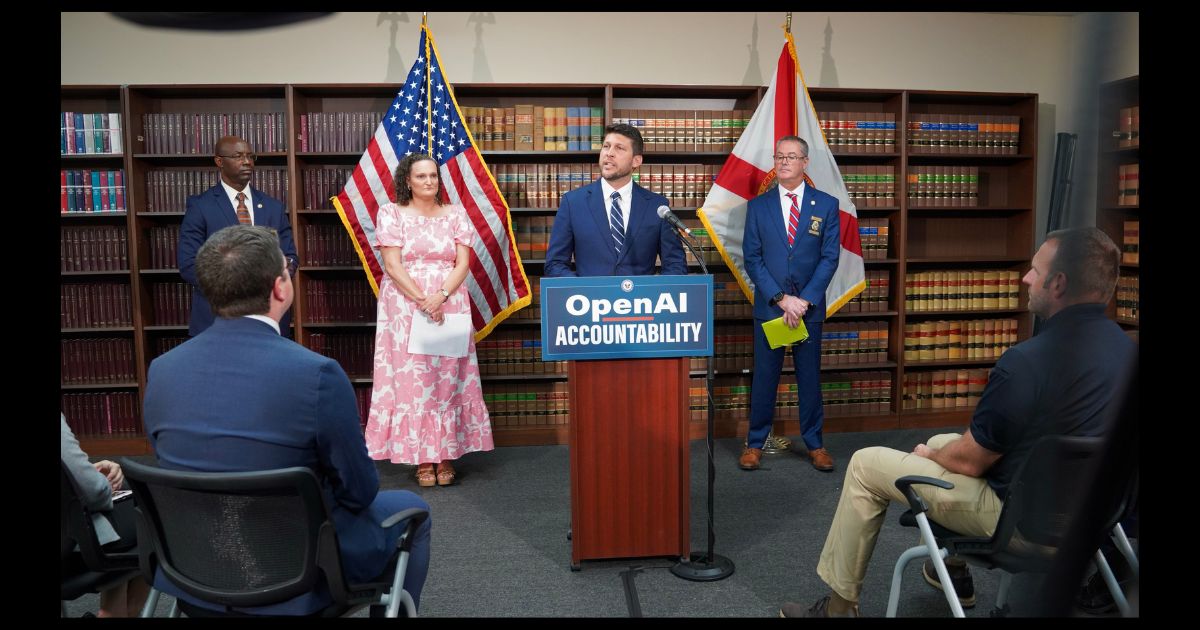
Florida officials say the lawsuit was filed under state laws prohibiting unfair and deceptive trade practices. The state is seeking damages on behalf of Floridians and an end to the practices described in the complaint.
The legal action follows a separate criminal investigation launched last month by the Office of Statewide Prosecution. Prosecutors began that investigation after reviewing chat logs between ChatGPT and Phoenix Ikner, the gunman who opened fire at Florida State University on April 17, 2025, killing two people and injuring several others.
That criminal investigation remains ongoing.
OTHER FLORIDA LEGAL NEWS:
Uthmeier also announced that the Office of Statewide Prosecution’s Cyber Fraud Enforcement Unit (CFEU) recovered and returned $229,096 in cryptocurrency forfeitures to victims of cyber scams over the past week.
Sarasota County Case – $139,400 in Restitution
This investigation began in October 2025 when the victim, a 69-year-old male, reported to the Sarasota County Sheriff’s Office that he had been the victim of a cryptocurrency scam. By phone, the scammer convinced the victim that he was a knowledgeable cryptocurrency investment advisor.
The scammer persuaded the victim to send over $970,000 to a fake investment app that falsely displayed gains of over $3.2 million. When the victim attempted to withdraw funds and was told he had to invest an additional $325,000 to do so, he contacted law enforcement.
CFEU recovered and returned $139,400 to the victim.
St. Johns County Case – $17,376
This investigation began in July 2025, when the victim, a 77-year-old female, reported to the St. Johns Sheriff’s Office that she had been the victim of a cryptocurrency scam. Scammers impersonating PayPal convinced the victim that her bank account had been compromised and that she needed to transfer all funds to Bitcoin.
The scammer persuaded the victim to make 17 transactions totaling $165,000, transferring funds to “Bitcoin machines” over 4 months. When the scammer ended communications and disconnected his phone number, the victim reported the crime.
CFEU recovered and returned $17,376 to the victim.
St. Johns County Case – $45,156 in Restitution
This investigation began in December 2024 when the victim reported to the St. Johns County Sheriff’s Office that she had been the victim of a cryptocurrency scam. The victim reported that she had met the scammer on the dating app “Coffee Meets Bagel,” and their conversation quickly moved to WhatsApp. The scammer, who falsely claimed to work at Goldman Sachs, led the victim to believe that he could advise her on successful cryptocurrency investments.
After initially convincing the victim to invest $1,000 through a fraudulent cryptocurrency platform, the scammer manipulated her into taking out loans and borrowing money from family members to invest additional funds. The fake investment platform falsely showed large profits and convinced the victim that her account balance had grown substantially. When the victim attempted to withdraw the funds, the scammer claimed she needed to pay nearly $59,000 in taxes before the money could be released. After speaking with family members and conducting additional research, the victim realized she had been defrauded.
The victim ultimately lost more than $108,000. CFEU recovered and returned $45,156 to the victim.
Marion County Case – $27,162
This investigation began in November 2024 when the victim, a 77-year-old male, reported the scam to the Marion County Sheriff’s Office. The victim met a female scammer on Facebook, and their conversation quickly moved to WhatsApp.
Over the course of approximately one year, the scammer manipulated the victim into investing over $160,000 into a fraudulent cryptocurrency platform. When the victim attempted to withdraw funds, he was told he would need to pay additional fees, at which point he reported the crime.
Through blockchain tracing, the Marion County Sheriff’s Office recovered some of the funds. CFEU was able to guide the funds through legal processes and return them to the victim in the amount of $27,162.