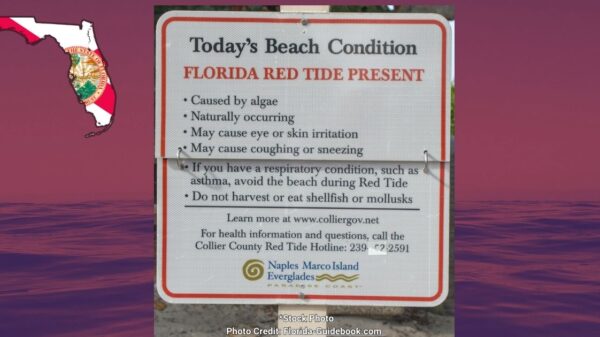
Red tides appear on the southwest Florida coast nearly every year, typically starting around September or October.
But now, a new model created by ECCO Scientific and The Everglades Foundation could predict an early-warning forecast system for red tide conditions along the southwest Florida coast weeks in advance.

Using scientific data, it could give an 84% accuracy, providing officials and the public time to protect public health and ecosystems before red tide hits,” said Miles Medina, Ph.D., ECCO Scientific, President and Lead Author.

The accuracy and effectiveness of the forecast system was analyzed in a 2024 Harmful Algae study by The Everglades Foundation and ECCO Scientific. The weekly forecasts now warn environmental managers and the public when red tide conditions are imminent, covering the Greater Charlotte Harbor area from Venice south to Estero Bay.
Red tide blooms first form offshore of Florida’s west coast. Under the right conditions, they are carried toward the southwest Florida coast by ocean currents, and nutrient-rich waters along the coast can sustain, prolong, and intensify the blooms. These nutrients come from a variety of sources both natural and man-made, including runoff and waste from our cities and farms, as well as releases from Lake Okeechobee.
The Everglades Foundation says new weekly forecasts will provide environmental managers, scientists, and the public with advance notice of red tide conditions to inform prevention and mitigation efforts. For example, the forecasts will enable the U.S. Army Corps of Engineers to avoid releasing nutrient-rich water from the Caloosahatchee River to the coast when a bloom is imminent, and timely public advisories and shellfish harvesting closures will protect the public from neurotoxin exposure. The recent grand opening of the Caloosahatchee River (C-43) Reservoir marks a step toward mitigating these harmful, nutrient-polluted discharges.

Development of the forecast models was led by ECCO Scientific, a small environmental research and consulting firm in Florida, with collaboration from The Everglades Foundation’s science team. The models use a machine learning algorithm to crunch a large amount of real-time environmental data from red tide samples, satellite imagery of Florida’s west coast, ocean buoys, and river gauges. Each week, the forecasts predict the “worst” red tide category (Background, Very Low, Low, Medium, or High) that is expected across the Greater Charlotte Harbor area over the next week and over the next four weeks. During testing, the forecasts achieved up to 84% accuracy and typically anticipated the onset of new blooms before they appeared.