Everyone agrees that sidewalks are important.
Where they connect neighborhoods, schools, parks, and businesses, sidewalks improve safety and encourage walking. But somewhere along the way, common sense gave way to bureaucracy.
Today, local governments are increasingly requiring builders to construct sidewalks that literally connect to nothing. Not sidewalks that complete a network. Not sidewalks that lead to schools. Not sidewalks that improve pedestrian safety. Not sidewalks that are part of a larger public infrastructure plan based upon input from the community.

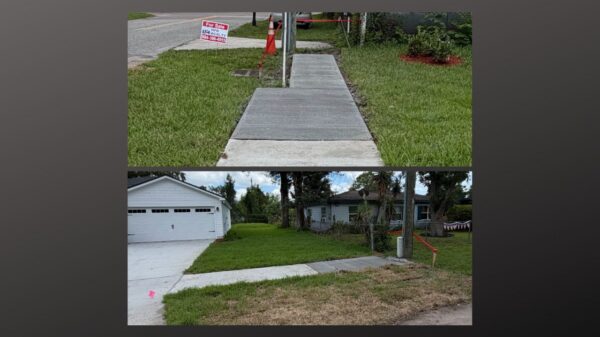
Instead, isolated sections of concrete are mandated by unelected bureaucrats in front of individual homes on roads where no sidewalks exist, where none are planned, and where they cannot practically be used.
The result?
Higher housing prices, more drainage issues, and ugly pieces of concrete that no one will use because they don’t go anywhere. All without any corresponding public benefit.

In one northside Jacksonville neighborhood, a builder is attempting to construct homes on lots that have existed since the early 1950s. The subdivision consists of existing roads that unelected bureaucrats have decided are not their responsibility.
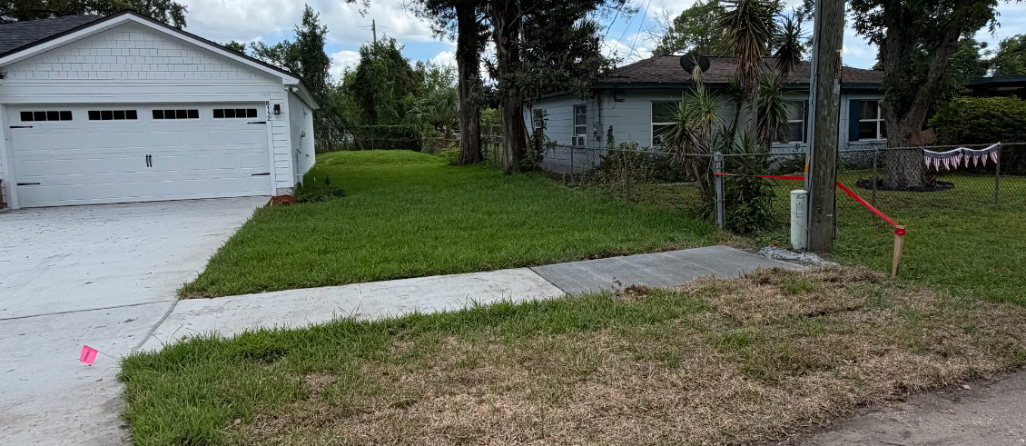
Utility poles line the edge of the roadway, and open drainage ditches occupy the area where sidewalks would normally be installed. The neighborhood does not connect to any other neighborhoods, nor are there any nearby schools, job centers, or transit stops that make new sidewalks needed. Most importantly, there are no sidewalks for this neighborhood to connect to.
Despite these conditions, the City has required sidewalks.

The sidewalks would not connect to an existing sidewalk. They would not connect to a future sidewalk. They would simply begin at one property line and end at the next.

In other words, a slab of expensive concrete that has to meet local, state and federal laws, as well as, whatever policy some bureaucrat dreamed up.
This is more than an inconvenience.
Modern sidewalks are designed to work with an entire transportation system. They typically accompany curb and gutter, stormwater facilities, ADA-compliant intersections, drainage structures, and maintained roadways.

None of those things exist in many neighborhoods where the City of Jacksonville’s public works department is requiring sidewalks.
So instead of listening to their constituents and common sense, the City is forcing builders to fit sidewalks between existing utility poles, drainage ditches, mailboxes, and private driveways on roads that the City itself does not maintain. If they can’t fit? The builder has to pay to have facilities moved? The cost? Paid by the home buyer.
The practical question becomes obvious:
Where exactly is the sidewalk supposed to go?
Every new regulatory requirement eventually shows up somewhere. Builders do not absorb these costs forever. They become part of the price of every new home. Concrete. Engineering. Surveying. Drainage modifications. Utility relocation. Permitting. Inspections.
Every unnecessary requirement adds thousands of dollars that ultimately become part of a family’s mortgage.
Politicians often talks about affordable housing while simultaneously their appointees impose regulations that make housing more expensive.
Those two goals cannot coexist indefinitely.
The irony is Jacksonville already recognizes that this is idiotic and has provisions that allow for deviations. Recognizing the issue, the City Council enacted an ordinance that authorizes sidewalk deferrals based on factors such as whether the roadway is City-maintained, whether sidewalks already exist nearby, and the character of the surrounding neighborhood. Keep in mind that this doesn’t mean the sidewalk NEVER gets poured. It’s deferred until the City comes up with a plan for sidewalks in a neighborhood.
The law exists because rigid rules cannot anticipate every circumstance. Situations like:
A road without City maintenance.
Open drainage ditches.
Existing utility poles.
No nearby sidewalks.
No pedestrian destinations.
Those are precisely the kinds of facts that call for flexibility rather than blind adherence to a checklist.
This debate is not really about sidewalks.
It is about whether regulations should accomplish something meaningful.
A sidewalk that safely connects people to destinations serves an important public purpose.
A twenty-foot section of concrete ending in grass does not.
Every unnecessary regulation has a cost.
Sometimes that cost is measured in dollars.
Sometimes it is measured in homes that never get built.
And sometimes it is measured in families who can no longer afford to buy one.
If governments are serious about making housing more affordable, they should start by asking a simple question before imposing another requirement:
If the answer is no, perhaps the people in charge—not the builder—is what needs to change.