The Everglades is far too valuable an asset to be allowed to deteriorate.
It’s time we look at America’s Everglades in a new way.
This iconic natural wonder is much more than habitat for threatened and endangered species of animals and plants, more than a source for recreation. It is more, even, than a buffer against storms and a provider of fresh drinking water for South Florida.
The Everglades is an economic powerhouse that fuels much of the economy of South Florida and supports millions of jobs.
In collaboration with Florida Gulf Coast University, The Everglades Foundation has identified an eye-popping 84,000 businesses in the 16- county Everglades watershed that are wholly or in large part dependent upon clean water and a healthy Everglades system for their very existence.

Together, these 84,000 businesses employ more than 2 million South Floridians, generating $223.5 billion annually in economic activity. Taking into account their suppliers and the ripple effects on the economy as a whole, economists have calculated that more than three million of us depend on the Everglades for our livelihoods.


We call this the “Clean Water Economy,” because that’s exactly what it is: an entire economic ecosystem in Southwest Florida that is propelled by a healthy, restored Everglades.
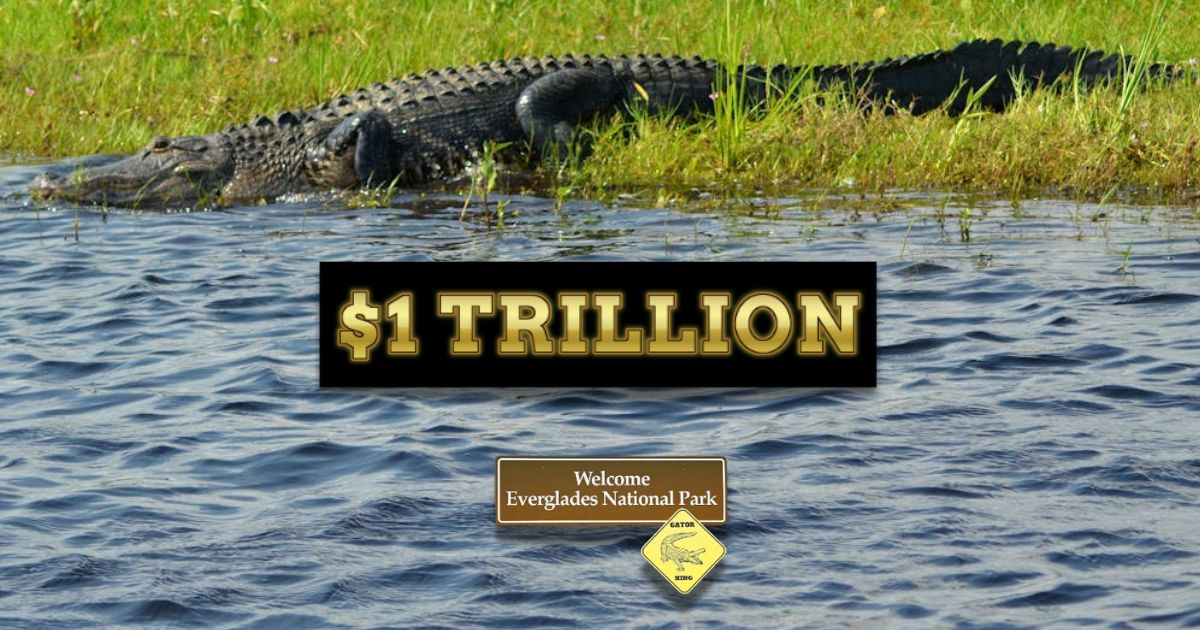
Altogether, Earth Economics calculates that the Everglades itself generates $31.5 billion in economic benefits every year. Over a 50-year period, America’s Everglades is a $1 trillion asset.
Like any other property, the Everglades must be properly maintained to continue producing value. If we allow water to be contaminated and fish to die, the economic benefits are reduced – and that’s what’s been happening in recent years.

Consider Florida’s real estate, tourism, and hospitality industries. Earth Economics rightly notes that their value shrinks when, as happened in 2016 and 2018, our waterways are clogged with toxic blue-green algae and red tide. As folks in Collier County know all too well, few people buy homes or plan vacations when beaches are closed and reek of dead fish.
Similarly, commercial fishing generates $116 million annually, but not when the salinity of Florida Bay causes fish die-offs. Yet those are the environmental consequences of channeling fresh water away from its natural southerly path.
Over the last century, instead of maintaining the watershed, we altered its natural flow with canals, dams, reservoirs, pumps and lift stations. Today, more than half the water that used to flow into Florida Bay is now rerouted out to sea, where it gives rise to the harmful algae blooms that ruin Florida summers.
The rechanneling of all this water has had another consequence. In Florida Bay, once gin-clear waters become cloudy when the fragile salinity of the estuary is altered. One of the world’s great fisheries is literally suffocated. While the environmental consequences are obvious, the economic ones can be devastating to the hundreds of small businesses that count on anglers for their incomes..
Restoration is proceeding, however, and it is working. With the construction of Tamiami Trail bridges and 11 miles of seepage barriers, Everglades National Park and Florida Bay are both seeing increased freshwater flows.
Meanwhile, important projects of the Central Everglades Plan, including the critical EAA Reservoir, have been accelerated for completion by 2029. When fully operational, the EAA Reservoir will increase the flow of clean freshwater to the central Everglades by 120 billion gallons annually and cut unwanted discharges of polluted lake water by more than half.
The cost of restoration, while substantial, is nothing compared to the value of the asset and the income it generates.
Long before economists were able to calculate the Everglades as a $1 trillion resource, investments in Everglades restoration proved worth it, generating a return of $4 for every $1 invested. That’s why we can’t stop now. The Everglades is too important, too much a part of our legacy, to ever turn back – and as we now know, it is far too valuable an asset to be allowed to deteriorate.
Eric Eikenberg is the CEO and Paul Hindsley, PhD, is the Chief Economist at The Everglades Foundation.