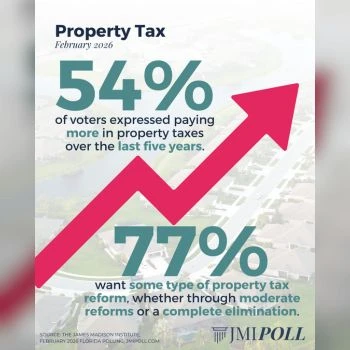
The Florida House of Representatives Select Committee on Property Taxes meeting last week provided a glimpse into some ideas for addressing property tax rates.
Property taxes are by far the largest source of tax revenue for Florida’s local governments, generating $55 billion in 2024 for counties, school districts, municipalities, and special districts, and that amount is rising rapidly. Of this total, $19 billion is paid by Florida homeowners.
The dollars from local property taxes fund critical government services, including public safety, fire protection, education, and sanitation. Over the last several years, local governments have taken in more revenue. Not by raising taxes, but by seeing the value of properties rise, which brings in millions of dollars.
Florida TaxWatch believes some plans could give voters a choice to reduce taxes while maintaining government services.

Option 1. Phase Out Property Taxes for Florida Homeowners

TaxWatch suggests that this could be achieved through a phased elimination over the years by increasing the homestead exemption, converting it from a dollar amount to a percentage of the assessed value. Policy makers could determine any length of time over which to phase out ad valorem taxes for homestead properties.

Under the 10-year plan, increasing the current exemptions to account for 25 percent of the frozen Year 1 assessed value of homestead properties in the second year, and then an incremental 10 percent each subsequent year, would eliminate property taxes on the current five million homestead properties in 10 years. This phased proposal would provide a $1 billion tax cut in the second year. Under the 30-year plan, the exemption value rises at a slower pace compared to the 10-year plan, resulting in a steady reduction of $655.2 million in homestead property taxes annually.
Option 2. Prioritize Eliminating Property Taxes for Senior Floridian Homeowners
If seniors remain in their homes as long as they are physically able, any phased proposal to eliminate property taxes for homeowners could be retroactive for senior citizens aged 65 years and older, allowing prior years to count towards the total number of years outlined. For example, under the 10-year phased elimination proposal, eligible seniors who have claimed homestead in Florida for at least 10 years would receive a 100 percent exemption of their home’s assessed value in the first year.

Option 3. Eliminate Property Taxes for Florida Homeowners, Except for School Property Taxes
School ad valorem taxes bring in around $21.5 billion for school districts. Approximately $13.7 billion of these total funds pay for almost half of the state’s $29.5 billion Florida Education Finance Program, which funds the state’s K-12 public schools.
TaxWatch speculated that policymakers may determine to keep all school levies in effect and eliminate only non-school property taxes to ensure there is enough tax revenue to fund public schools.
Option 4. Lower Property Taxes for Florida Homeowners
“A proposal to simply lower a property owner’s tax liability is to provide each property in the state with a set percent reduction of the previous year’s assessed value and require all local governments to adopt the previous year’s millage rates. For the next five years, local governments must adopt the roll-back rate, with the set percent reduction added back for the calculation,” said Florida TaxWatch Senior Vice President of Research Kurt Wenner.