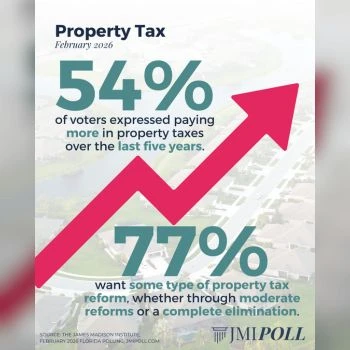
After nearly two years of waiting, Floridians finally get the chance to vote on the official property tax proposal from Gov. Ron DeSantis. It is certainly ambitious, with two enormous positives. Inflation has reduced the value of the current homestead exemption and raising it to $150,000 in 2027 fully offsets that dollar value loss. Also, commercial property owners would benefit, too, with their cap on assessment increases dropping from 10% to 5%. These are major changes and are central to consideration of the proposal.
Unfortunately, there are still several places where the amendment falls short, particularly of the promise to “repeal property taxes”. Neither the expanded homestead nor the 5% cap apply to school taxes. Homesteaders are likely to be shocked to see that they still have a school tax bill for thousands of dollars in 2027, while commercial properties, which already pay more than 60% of their tax bills toward school taxes alone, will find their share only grows as the homestead exemption expands.
There was also an effort to limit how local governments spend property tax money to essential items only. While the list was expanded to include important legal obligations, such as constitutional offices, administration and permitting, the problem of undefined terms lurks underneath, meaning courts could end up deciding what they mean instead of lawmakers.


The biggest attention-getter is the plan to expand the homestead exemption to $250,000 in 2028. First, if the goal is to restore the impact of the original 1934 exemption it would need to exceed $400,000. But the real lingering question is speed. Jumping from $50,000 to $250,000 in just two years is a huge leap. Without a clear plan to replace lost revenue in cities and counties with mostly residential property, the proposal could fall short of the 60% voter approval needed. Remember, voters did not even approve of a $100,000 exemption in 2018.
The proposal also requires new homesteaders to wait five years before receiving the expanded benefit. Unfortunately, this type of provision has repeatedly been found unconstitutional under Equal Protection claims. While it should be severable, including it guarantees the amendment will be taken to court and could risk throwing the baby out with the bathwater.
However, the most glaring problem is what the proposal does not address, and it could spark a taxpayer revolt in 2027. Non-ad valorem assessments are flat-fee property taxes that are not based on property value. There are no limits on them. So, if local governments lose 20% to 30% of their millage property tax base, they will likely use these flat fees to make up the difference. Ironically, many homeowners could end up paying more in taxes in 2027 because of it. Even worse, these assessments do not include the usual exemptions for churches, schools, the blind, widows or disabled veterans. Voters will have to trust that lawmakers will close this loophole in a future Session.

This amendment is truly a mixed bag, with potential savings for some taxpayers, while others will likely feel the pinch of a tax shift. For my part, I am certain that no matter how voters choose in November, the items left undone will demand that Tallahassee dig deeper on this issue in the coming years.
Matt Caldwell is the Property Appraiser for Lee County