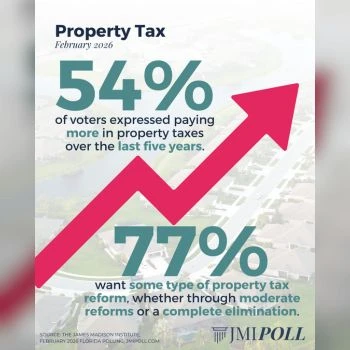
Lawmakers looking at putting property tax cut measures on the 2026 state ballot have released seven joint resolutions.
In November, the House Select Committee on Property Taxes said its current tax relief proposals would not impact funding revenue for education and first responders.
The following proposals are:
HJR 213 would change the caps on the Save Our Homes plan, allowing the assessment increase at 15% over three years, rather than the original 10%.

HJR 211 removes the $500,000 cap on taxable value, eliminating the discrepancy between the taxable and market value.

HJR 209 supports an amendment to the Florida Constitution to create an exemption from non-school property taxes for $200,000 of the assessed value of homestead properties or homesteads covered by a comprehensive, multi-peril, property insurance policy.

HJR 207 creates a non-school homestead exemption equal to 25% of the remaining excess value after current exemptions are applied. Across Florida, for every $100,000 of assessed value for a homestead property in an area with a millage rate of 4, the tax savings for a homeowner would be $100 for every $100,000 of assessed value.
HJR 203 would phase out non-school ad valorem taxes over 10 years by increasing homestead exemptions by $100,000 a year, beginning in 2027.
HJR 205 eliminates the non-school property tax for homesteads owned by persons 65 years of age and older.

HJR 201 would remove all ad valorem taxes associated with homesteads except for school expenses and law enforcement.
HB 215 allows married couples to combine their separate save-our-homes portability benefits when establishing a joint homestead up to the existing $500,000 cap. It also requires any increase to the prior year’s adopted millage rate to be approved by a ⅔ vote of the local governing body.
All elected Republicans voted in favor of moving the bills, while all Democrats opposed them.
Whatever proposal or proposals get approved by the state House and Senate for placement on the 2026 ballot would still have to pass by 60% of voters before becoming part of the state constitution.