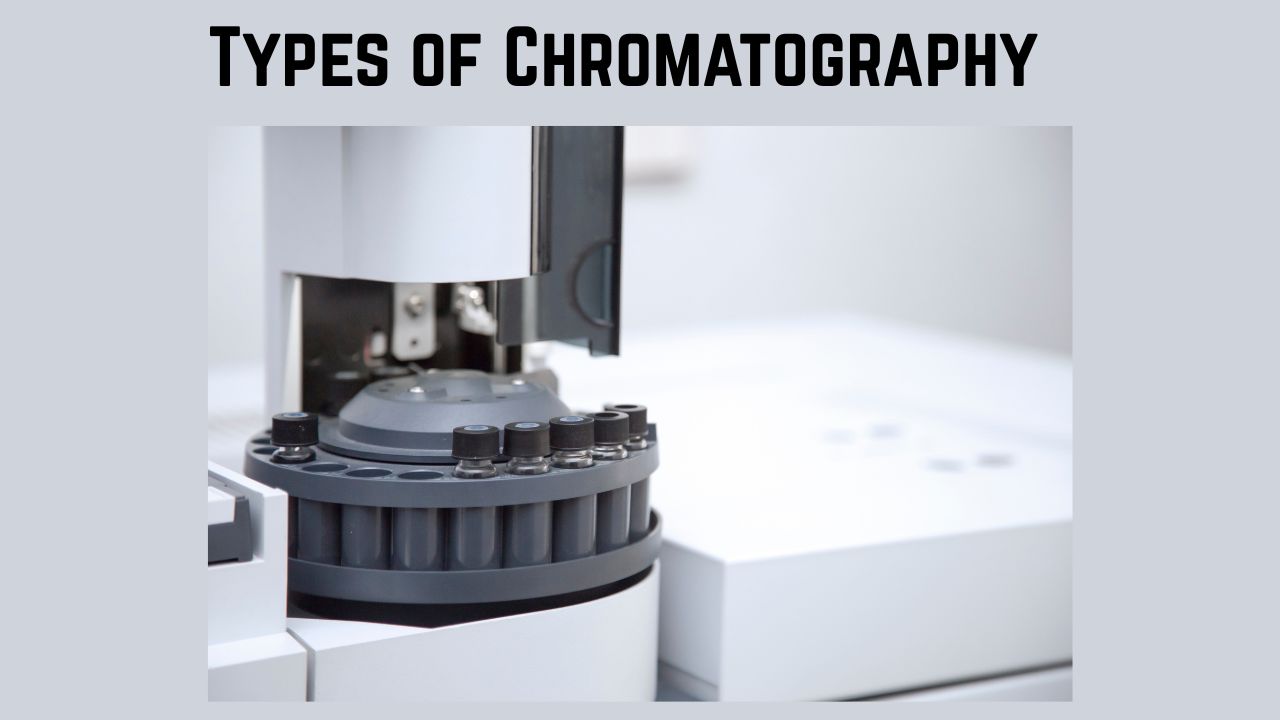
Chromatography is an important technique for separating chemical compounds of a mixture into their components. Laboratories, pharmaceuticals, and the food industry extensively use this technique. Understanding its various forms is crucial to fully realizing its scientific and practical significance.
Learning about the chromatography main types helps researchers and professionals choose the right method for their specific applications. Each type offers unique advantages depending on the nature of the analysis required. Let’s begin by exploring the fundamental concept behind this versatile technique.
What Is Chromatography?
Chromatography is, at the most basic level, the separation of compounds as they move through a medium. Based on the type, this movement can take place in the liquid phase or the gas phase. This process operates on the fundamental principle of different affinities of the substance for a particular stationary and mobile phase, due to which the components separate from each other and become amenable to further analysis.
Paper Chromatography
One of the simplest forms is paper chromatography. Its stationary phase is a strip of paper. A small droplet of the mixture is deposited near the base of the paper, which is then immersed in a solvent. The components are moved at various rates along with the solvent as it travels up. This method is typically used for pigment identification or screening.

Thin Layer Chromatography (TLC)
Like paper chromatography, but with a different stationary phase, thin-layer chromatography (TLC) uses a thin layer of silica gel or alumina rather than paper. The mixture is dropped on top of the layer, and the plate is put in a solvent. TLC gives more accurate results as compared to paper chromatography and has a wider range of applications, such as monitoring of reactions and purity testing.
Gas Chromatography (GC)
Gas chromatography is suitable for volatile compounds. With this method, the mobile phase is an inert gas and the stationary phase is a liquid or solid material coiled into a long column. The sample is heated up, vaporized, and passed through the column. It ensures that each component comes out at a separate time so that you can analyze it in more detail. It is an important technique in environmental testing and essential oils testing.

Liquid Chromatography (LC)
A liquid mobile phase and a solid stationary phase make up liquid chromatography. There are various types of chromatographic methods, such as high-performance liquid chromatography (HPLC), which works at high pressure, so separation is quicker and more efficient. According to the U.S. Pharmacopeia, HPLC is one of the most widely used analytical techniques for pharmaceutical quality control and regulatory compliance. This technique is crucial in the pharmaceutical industry for purity examination and quality checks.
Affinity Chromatography
Though it does not rely on direct chemical bonding, affinity chromatography capitalizes on natural interactions between molecules. The stationary phase is a medium that specifically binds to a certain molecule of interest. After removal of the undesired material, the target is eluted. This method is especially used in the purification of proteins and enzymes in biochemistry.

Ion Exchange Chromatography
Within this form, analytes are separated according to their ion exchanger affinities, and polar molecules are included as well. The stationary phase is charged and attracts oppositely charged ions. The separation can be controlled by changing the pH or the salt concentration. Ion exchange chromatography plays an important role in water purification and protein separation.
Size Exclusion Chromatography
Known as gel filtration chromatography, this technique separates molecules by size as well. The stationary phase is made of beads with small pores, and smaller molecules take longer to pass through than larger ones. This technique is useful for the separation of larger biomolecules and for measuring molecular weights.
Applications of Chromatography
Chromatography has a wide range of applications in almost every industry. In the food industry, it analyzes additives and contaminants to maintain quality and ensure safety. It is used for drug analysis and metabolic studies in the field of medicine. It is then employed by environmental agencies to test for pollutants, which can be used to verify regulatory compliance. The versatility of it indeed reinforces its significance in scientific and practical applications.
Conclusion
Given the extensive realms of chromatography and its applications, having an overview of the different types of chromatography helps to recognize what it is useful for, its applications, and its benefits. These range from simple paper methods to more advanced gas and liquid systems. Such awareness will help scientists and industries choose which technique is appropriate for their purposes, and their decisions will be facilitated by a better understanding of these differences. Chromatography remains a pillar of analytical science, enabling various advances and quality assurance in many different areas.