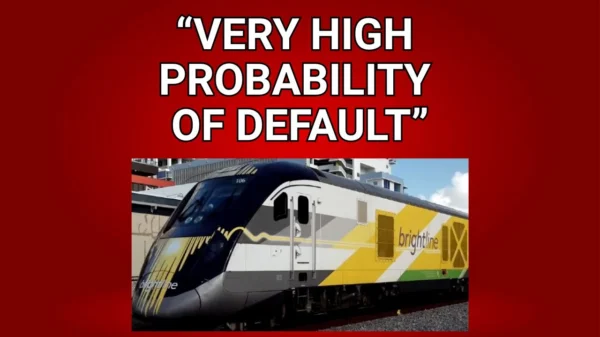
Brightline Florida, the nation’s only privately operated intercity passenger railroad, is facing mounting financial pressure after deferring a second bond payment in six months—raising renewed questions about whether private passenger rail can be financially viable in the United States without sustained public support.
Second missed payment highlights growing stress
Brightline Florida disclosed this week that it deferred a January 15 interest payment on $1.2 billion in subordinate municipal bonds, requiring bondholders to waive the cash payment requirement. The move follows a missed payment in July and underscores the railroad’s deepening liquidity constraints.
In exchange for the waiver, Brightline agreed to raise the collateral valuation tied to a potential Tampa extension from $650 million to $850 million, effectively setting a floor for bonds now trading at roughly 33 cents on the dollar.
The deferral came as credit agencies continue to sound alarms. S&P Global Ratings downgraded $2.2 billion of Brightline’s municipal bonds five notches in December—from BB- to CCC—warning of a “higher probability of default by January 2027.” Fitch Ratings followed on January 16 with further downgrades, cutting Brightline Trains Florida LLC’s senior secured private activity bonds to CCC and the parent-level Brightline East LLC notes to CC, both remaining on Rating Watch Negative.
A debt stack under strain
Brightline’s challenges are magnified by its $5.5 billion capital structure, which spans multiple layers of debt with different seniority. While the senior-most $2.2 billion in tax-exempt municipal bonds remain current, Brightline tapped its debt service reserve account to make a January 1 payment on a 2024 bond series—another signal of tightening liquidity.
The most acute stress is concentrated in junior debt. The $1.2 billion in subordinate municipal bonds has now seen two consecutive interest deferrals, while $1.1 billion in corporate bonds due in 2030—largely held by hedge funds—has become the focal point of restructuring discussions.

Fitch warned that a slower-than-expected ridership ramp-up left Brightline without sufficient operational cash flow to cover January 2026 debt service without reserve draws. Absent a sharp improvement in revenue or new capital, Fitch projects a high likelihood of default by mid-2027.
Popular trains, unprofitable math
At the core of Brightline’s problems is a simple mismatch between popularity and profitability.


The 235-mile Miami-to-Orlando corridor carried 3.1 million passengers in 2025, a meaningful increase from earlier years but still 54% below projections used in its 2024 bond offering. Revenue ran roughly 67% below forecasts.
According to reporting by the Palm Beach Post, Brightline spent about $341 million operating trains and stations in 2024 while generating approximately $188 million in ticket and ancillary revenue—an operating deficit of more than $153 million. Interest expense added another $178 million.
S&P estimates Brightline would need to boost ticket revenue by roughly 51% in 2026 to stabilize finances—requiring either dramatic ridership growth, significant fare increases, or both.
Operational tweaks offer limited relief
Brightline has taken steps to improve performance. In October, it restructured schedules to add capacity on high-demand routes and increased short-distance frequency during commuter periods. The changes delivered a short-term boost: November revenue rose 18% year over year to $17.5 million on 280,136 riders.
Still, rating agencies remain skeptical that operational improvements alone can close the gap between revenue and escalating debt service.
“Liquidity available would be insufficient to meet debt service obligations beyond early 2027 without additional capital,” S&P said in its December downgrade.
Searching for lifelines
To avoid default, Brightline is pursuing several options simultaneously:
- Equity raise: The company says it is “actively progressing the planned issuance of a substantial amount of equity,” engaging potential strategic partners globally. Proceeds would be used to retire higher-coupon parent debt and rebuild cash reserves.
- Additional debt: Investor disclosures reference discussions for up to $100 million in new borrowing to meet near-term obligations and address potential adverse outcomes from ongoing litigation, including disputes with Florida East Coast Railway over trackage rights and maintenance fees.
- Restructuring: Hedge fund creditors holding corporate bonds are preparing restructuring proposals that could elevate their claims while injecting new capital.
Behind Brightline stands Fortress Investment Group, the SoftBank-owned asset manager that has backed the railroad since its inception. Fortress has provided capital during construction, supported multiple debt offerings, and continued funding operations despite mounting losses.
But rating agencies have begun to flag concerns about Fortress’s exposure. December downgrades extended to Fortress-level debt, as the firm simultaneously backs the $12 billion Brightline West project connecting Las Vegas and Southern California, which broke ground in 2024.
How much additional capital Fortress is willing to commit to the Florida operation remains an open—and critical—question.
Brightline’s struggles extend beyond bondholders. The railroad operates in a transportation ecosystem where highways, airports, and air traffic control systems receive heavy public subsidies, while Brightline must cover both operating costs and billions in debt service from fare revenue alone.
Supporters argue the company’s difficulties stem from execution issues—overly optimistic forecasts, expensive debt structures, and litigation costs—rather than a fatal flaw in private rail. Critics counter that intercity passenger rail is inherently a public good, ill-suited to purely private financing.
The contrast with Brightline West is telling. That project has secured $3 billion in federal loans, creating a hybrid public-private model that may prove more durable than Brightline Florida’s fully private approach.
Key developments to watch include progress on an equity raise, negotiations among competing creditor groups, and whether recent ridership gains can be sustained. Brightline has also floated a Tampa extension, but expanding service while struggling to meet existing obligations would require substantial new capital.
For municipal bond investors, Brightline has become a cautionary tale: tax-exempt infrastructure debt can still carry significant risk when optimistic projections collide with economic reality.
Whether Brightline can navigate its financial crossroads—or becomes a warning example for future private infrastructure projects—may shape the future of passenger rail investment in the United States.