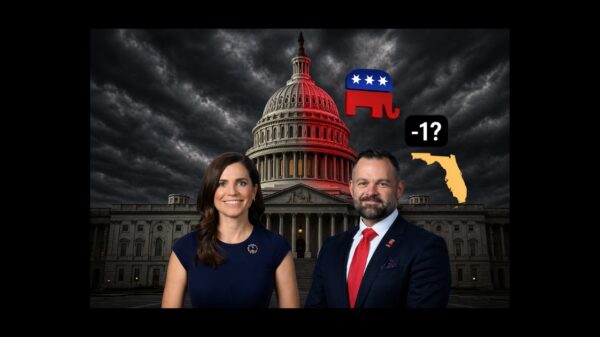
Florida is one of several states looking to redraw congressional maps to increase their stronghold in Congress.
A new report by Florida TaxWatch examines Florida’s history of census undercounts, the consequences on Florida’s loss of a congressional seat, and considerations to support the 2030 Census.
The analysis by TaxWatch starts off stating that during the 2020 census, an estimated 750,000 Floridians failed to respond to their census survey, resulting in a statistically significant undercount of 3.48 percent. And because of that, the undercount cost the State at least one additional seat in the U.S. House of Representatives, and at least one additional vote in the Electoral College, and billions of dollars’ worth of grant funding throughout the decade.
The group now lays out some ideas that could benefit the GOP.
Scenario 1 – If all residents of the United States were accurately counted in 2020. TaxWatch says the if the 2020 census count was more accurate, three states would have gained an additional seat—Florida, Tennessee, and Texas. Due to census miscounts, those seats now belong to Colorado, Minnesota, and Rhode Island.

Scenario 2 – If all legal residents of the United States were accurately counted in 2020.
If the 2020 census numbers were based on a more accurate count and excluded illegal immigrants, five states would have gained one or more additional seats—Florida, Louisiana, Ohio, Texas, and Virginia. Four states would lose one or more seats—California, Minnesota, New York, and Rhode Island.
Scenario 3 – If only citizens of the United States were accurately counted in 2020.
TaxWatch says if the 2020 census count excluded non-citizens, seven states would have gained an additional seat—Florida, Louisiana, Missouri, Ohio, Pennsylvania, Virginia, and West Virginia. Meanwhile, California would lose three seats, New York would lose two seats, and Minnesota and Rhode Island would each lose one seat.