This is a part 1 of an investigative series on money and influence in high‑stakes healthcare policy decisions and how an undisclosed poll and an opaque “taxpayer” group helped shape the fight over a local healthcare bill.
A recent Broward County poll appears, at first glance, to answer a straightforward question: what do voters think about a proposal involving their public hospital districts? Look closer, and it raises another: how much do we actually know about the full machinery — polls, paid messaging, and money flows — that now shapes local healthcare debates with enormous financial stakes.
Earlier this year, state lawmakers filed House Bill 1047 and Senate Bill 1122, sponsored by Rep. Hillary Cassel and Sen. Joe Gruters.
The proposal later stalled in committee and died when this year’s Legislative Session ended. The bills would let Broward Health and Memorial Healthcare System work together more closely on certain services, contracts, and planning, under state oversight, while still remaining two separate public hospital systems with their own boards, budgets, and open‑meeting requirements.
Supporters say that kind of collaboration is needed to keep key services going and expand access to care as the healthcare market changes; critics worry it could weaken competition.

Rewind a few weeks. Before those bills were even filed, a Tallahassee polling firm called The Tyson Group.
had already tested how Broward voters would react to a more loaded description of the idea.
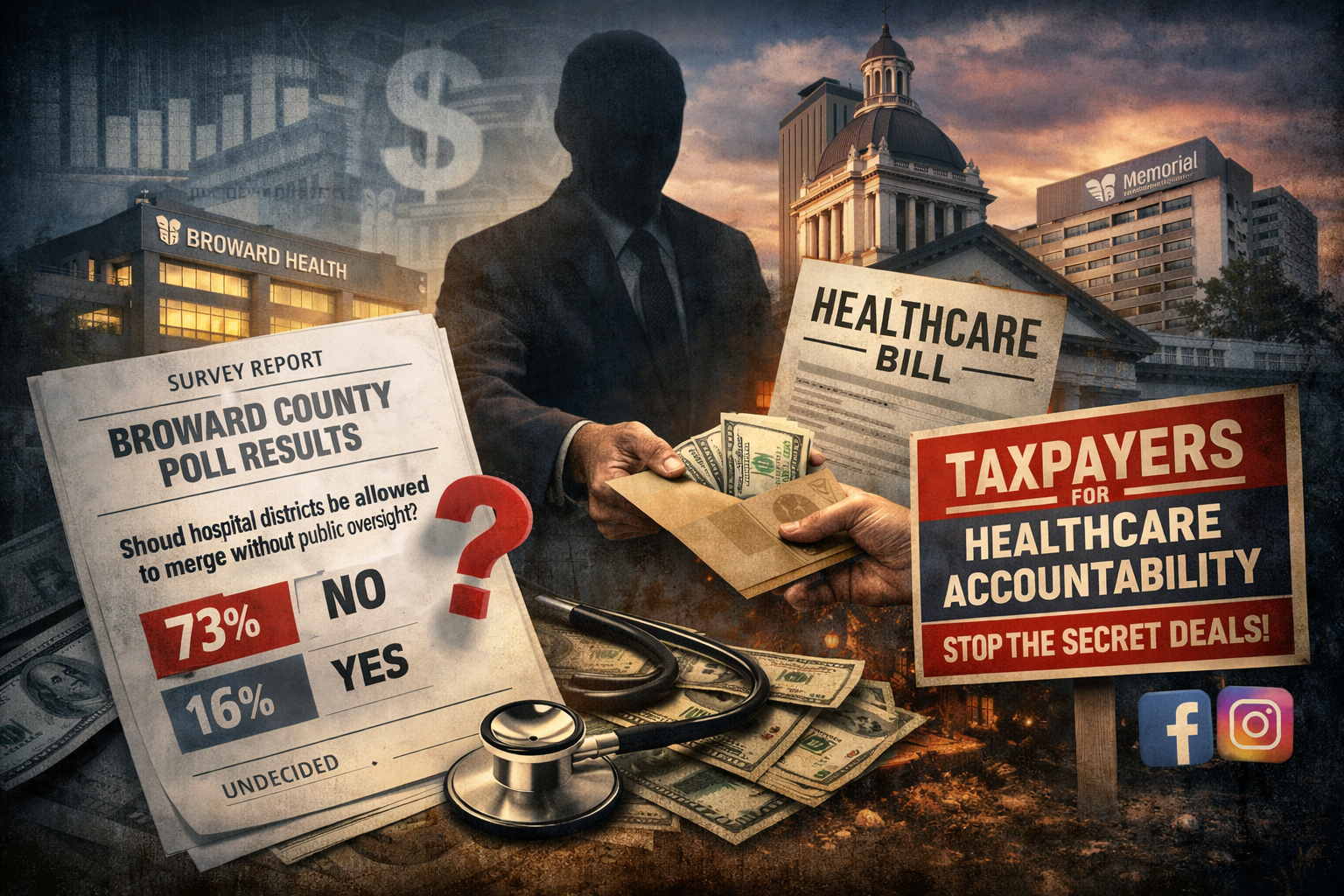
The Tyson Group, run by longtime political consultant Ryan Tyson, surveyed 500 “likely voters” in Broward County. One of the main questions didn’t name a bill or quote any legal language. Instead, it asked whether the North and South Broward Hospital Districts should be allowed to change how they operate “without triggering the legal requirements, transparency, or voter approval normally required for a full merger.” When voters heard that version, 73% said the districts should not be allowed to do it, including 62% who said “definitely no;” only 16% said yes
When HB 1047 and SB 1122 were introduced in January, The Tyson Group results moved quickly into the public conversation. Florida Politics reported that a poll showed Broward voters cool to a “shared services agreement” between the hospital districts and highlighted the 73% “no” number. The South Florida Sun Sentinel later referenced the same polling in its coverage of the bills.
Neither outlet’s published story identified who commissioned or paid for the survey, and neither printed the full wording of the questions or detailed polling methods.
Around the same time the poll began showing up in headlines, a new player appeared in the debate: a group calling itself Taxpayers for Healthcare Accountability. Its website says it is “a project of Florida’s Future First,” which ProPublica’s Nonprofit Explorer lists as a 501(c)(4) organization based in Tallahassee. Under federal rules, 501(c)(4) groups can spend money to influence public debates but are not required to publicly list their donors, so residents can see the messages but not who is paying for them.
Soon after the website went live, Meta’s ad library began showing paid messages from Taxpayers for Healthcare Accountability targeted to Broward and Tallahassee audiences on Facebook and Instagram. One ad warned that HB 1047 would let “taxpayer‑funded hospital districts merge without a public vote” and said, “when competition drops, prices rise.” The wording in those ads closely mirrors The Tyson Group question about changing how the districts operate “without…transparency, or voter approval…for a full merger,” although the bills themselves keep the two districts separate and do not authorize a merger.
Very little public information is available about who is behind the campaign. Taxpayers for Healthcare Accountability’s materials do not list officers, board members, or major donors; the main detail is its link to Florida’s Future First. Filings for Florida’s Future First contain the basics required of 501(c)(4) organizations but do not name specific contributors, so the individuals or entities financing the ads cannot be easily identified from public records.
Taken together, the timing of the poll, its focus on a merger scenario not found in the bill text, the lack of disclosed sponsorship, and the overlap between its language and later advertising show how several important pieces of this debate are unfolding outside public view.