This is part 2 of an investigative series on money and influence in high‑stakes healthcare policy decisions and how a Tallahassee lawyer, a nondisclosing 501(c)(4), and a “taxpayer”‑branded ad campaign helped shape the debate over a Broward hospital bill while keeping their financial backers out of public view.
In the first installment of this series, Florida Daily examined how an undisclosed poll and a set of merger‑framed questions helped form public perception of House Bill 1047 and Senate Bill 1122. In this second part, the focus shifts from the message to the messengers: the nonprofit, vendors, and political operatives behind the “taxpayer” campaign that followed.
When Broward residents opened their mailboxes and phones this winter, many saw the same warning.
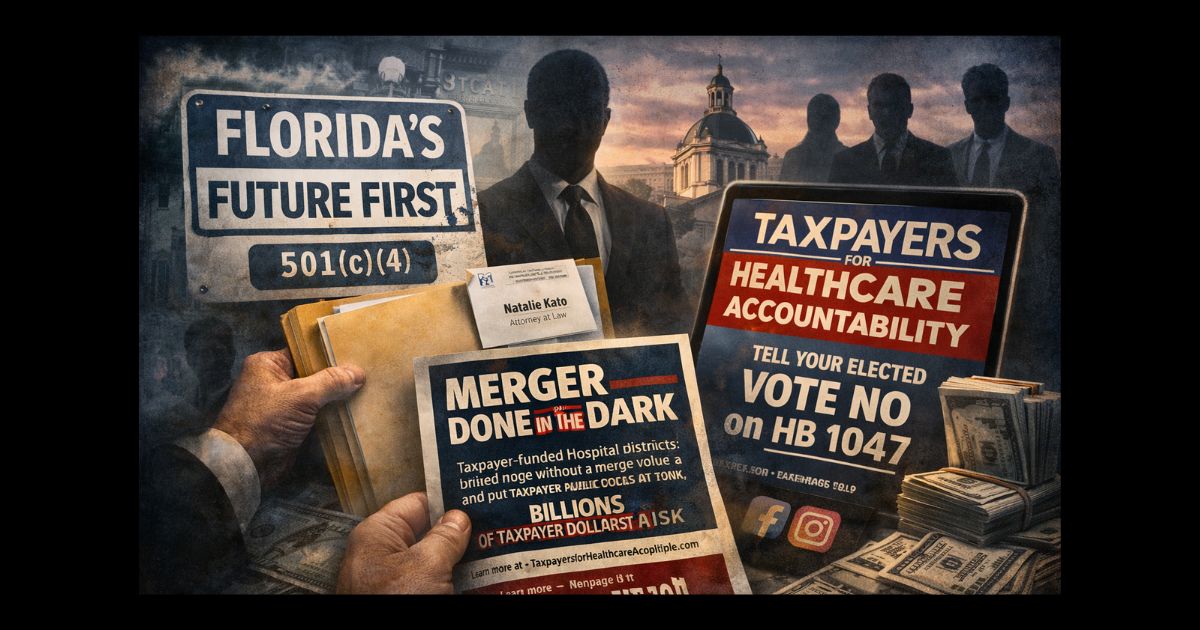
Glossy flyers, text messages, and digital and social media ads alerted of “a merger done in the dark” and said HB 1047 would let “taxpayer‑funded hospital districts merge without a public vote” and put “billions of taxpayer dollars” at risk.
Several materials urged residents to “TELL YOUR ELECTED OFFICIALS: VOTE NO on HB 1047,” and were all branded with the same name: Taxpayers for Healthcare Accountability.

What the ads did not disclose was who built that campaign or where its money came from.
Records point to a network centered on a Tallahassee lawyer, a nondisclosing nonprofit, and a national public affairs firm that together shaped the fight over Broward’s public hospitals – leaving residents to wonder who is funding the advocacy that sought to speak in their name, and why.
The bills at issue would have allowed Broward Health and Memorial Healthcare System to collaborate more closely on services, contracts, and planning under state oversight, while remaining separate public hospital districts with their own boards, budgets, and open‑meeting requirements.
A “local taxpayer”‑branded advocacy group nearly 500 miles from Broward.
On its website and in campaign materials, Taxpayers for Healthcare Accountability presents itself as a citizen-driven effort speaking for “Broward taxpayers” who “deserve a say,” and urges them to tell officials to oppose HB 1047.
In small print, the site concedes that the group is “A project of Florida’s Future First,” a nonprofit based in the state capital. Florida’s Future First is organized as a 501(c)(4), a tax status that allows it to spend on public policy campaigns but does not require it to list donors publicly.
Its filings list a Tallahassee mailing address and broad language about promoting “policies and thought leadership” that help Florida.
Florida’s Future First’s own website is sparse, offering only basic mission language, while Taxpayers for Healthcare Accountability.com functions as the more visible advocacy group: a campaign hub with a petition form, talking points against HB 1047, and repeated descriptions of the bill as a secretive “merger” plan.Both websites are arms of the same operation, yet only the Broward‑branded one is front‑and‑center in local mailboxes and news coverage.
Campaign finance experts say this kind of structure is increasingly common in legislative fights, allowing a 501(c)(4) to keep its own name in the background while promoting a separate, local‑sounding brand to voters.
The national digital influence firm that carried the narrative
Meta’s public Ad Library shows that Taxpayers for Healthcare Accountability has to date run 22 paid ads on Facebook and Instagram, aimed at audiences in Broward County and in Tallahassee.
Those anti‑HB 1047 ads used language that closely mirrored the December poll question tested by Tallahassee-based consultancy The Tyson Group, warning that public hospital districts could change how they operate without a public vote and, as one ad put it, that “expands monopoly power.” The wording tracked the poll described previously in this series, carrying its no-public-vote, less-transparency framing from a private survey script into a paid advertising campaign.
In the Ad Library, Mercury Public Affairs LLC – a national political consulting, digital marketing, and communications firm – is listed in Meta’s “about the advertiser” section as the “…organization that has completed our [Meta’s] verification process and claimed responsibility for this Page.” In the same Meta disclosure, Mercury, which has multiple Florida offices, is indicated as “responsible” for managing the Taxpayers for Healthcare Accountability social media pages tied to those ads, with the page management based out of Tampa, where Mercury has a local office.
While the records do not show exactly who hired Mercury – which on its website says it has 550 clients globally – or how much the firm was paid, they do confirm that a professional vendor handled the Meta ad placements for Taxpayers for Healthcare Accountability’s campaign opposing the public safety-net hospitals’ collaboration legislation.
The attorney behind recurring pop‑up groups
Taxpayers for Healthcare Accountability fits a pattern that has emerged around Tallahassee political attorney Natalie Kato, founder of Kato Law, whose work includes representing and helping launch newly formed nonprofits and political committees that appear during contentious legislative and municipal fights.
Public records indicate that Kato served as a registered agent for A Resilient Future Florida, a group that surfaced during the 2023 session in connection with a Miami Beach development legislative debate. Soon after lawmakers finished their work, the organization shut down. Investigative reporting by Seeking Rents linked that entity to what corporate-accountability reporter Jason Garcia described as a “dark lobbying” campaign in which donors remained hidden.
More recently, BocaFirst reported that Kato chairs a political committee called A Better Boca Raton, which paid for “One Boca” ads backing a controversial downtown government campus project.That reporting raised similar transparency questions about a Tallahassee‑linked operation fronting a major local advertising push and whether residents can see who is funding advocacy in their own community.
Corporate records and ProPublica Nonprofit Explorer data indicate Kato now plays a similar role at Florida’s Future First, handling the nonprofit’s filings while its donor base stays confidential.
Florida’s Future First’s website was registered before the 2026 legislative session, and the Taxpayers for Healthcare Accountability site came online in January, just as HB 1047 and its Senate companion began moving through the Capitol.
Taken together, these examples show how entities tied to the same small circle of professionals can move from one local policy fight to another, helping to shape high‑stakes decisions while revealing little about whose interests they represent.
The pieces the public still can’t see
Lobbying records and interviews confirm that major private health systems and other business interests opposed HB 1047/SB 1122, arguing that additional powers for Broward’s public hospital districts would distort competition.
Because 501(c)(4)s are not required to disclose donors, there is no public way to know which interests ultimately financed the Taxpayers for Healthcare Accountability effort or how much money was at stake.
Broward residents can see the bill text, the public statements from hospital districts and business groups, and the stream of mailers and digital ads urging them to reject what critics call a “backdoor merger.”
What they cannot see are the names behind the logo, or the full price tag of the campaign that helped shape the outcome of a local healthcare decision with billion‑dollar implications.
That opacity stands in sharp contrast to Broward Health and Memorial Healthcare System, which must publish their board rosters, budgets, and meeting agendas under Florida’s Sunshine Laws.
For a debate about publicly owned hospitals, experts say residents are entitled to know who is paying to influence their views and what interests those funders have at stake.
For now, the hospitals at the center of the fight continue to conduct their business in the open, while the network that fought their collaboration proposal remains largely in the dark.