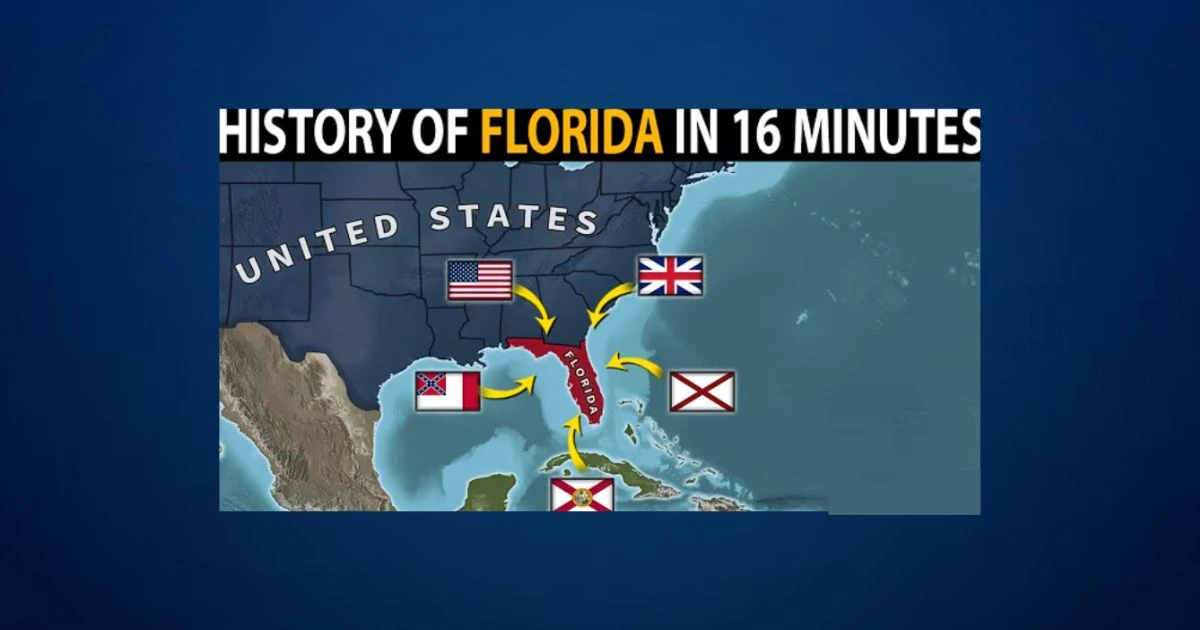
Below is a transcript of the video, which was produced by the YouTube Channel
Knowledgia:
The State of Florida is known worldwide as a perfect vacation spot. Warm weather, beautiful beaches, and theme parks like Walt Disney World all make it a great place to spend a little time.
The state also has a rich history and a great deal to offer those who would live and work there. For much of its geologic history, the land that is the state of Florida was underwater. This created sedimentary rock that produces some of the state’s important natural resources, such as potash and phosphorite, both of which are used to make fertilizer and other chemicals.
About 5 million years ago, this sea receded, leaving a vast grassland rich in animals and plants, which have also found their way into the fossil record. Florida is the place to look for fossils of Pline Aram mammals, like saber-tooth tigers, mastodons, short-faced bears, and giant sloths. The first human inhabitants of this Southeastern peninsula of North America were descendants of the people who crossed the Bering land bridge between 20,000 and 15,000 years ago.
Over a few thousand years, groups made their way from what is now Alaska all the way to the southern tip of South America, some staying here or there and becoming the ancestors of the modern indigenous people of the Americas.

There is evidence of settlement in Florida from at least 12,000 years ago, prehistoric groups living as hunter-gatherers alongside the last of the ice age. As agriculture developed, the group specialized according to their location.
The Kusa tribe in the southernmost part of the peninsula lived by fishing, hunting, and gathering and did not practice agriculture. In the northern part, the Uka and Appalachia cultures were agriculturalists. This rich soil was used to grow many crops, including most the most American of all grains – maze, or, as it is now better known, corn. They had extensive trade networks with the other tribes on the peninsula, as well as throughout the Americas.
These native peoples had no domesticated animals, whether for meat or use as beasts of burden. It is difficult to know how many people lived in Florida at the time of European contact, but estimates range from approximately 350,000 to 700,000. The first Europeans to colonize the peninsula arrived with the 1513 expedition of Juan Ponce De Leon.


It is likely that other Spaniards had already traveled through and traded in this area, as the expedition encountered at least one man who spoke Spanish. De Leon also gave the peninsula its European name: “La Florida,” in honor of the Spanish Easter celebration, the “Pasqua Florida,” which would have been celebrated around the time he landed.
It has also been said that the Spanish explored the area in hopes of finding the legendary Fountain of Youth, which could grant those who drank its waters “eternal youth,” but this was much more myth than reality. These early colonial ventures were unsuccessful. The Spanish were driven off by natives, and, in one case, a hurricane.

It was not until the founding of St Augustine in 1565 that a permanent Spanish colony was established it was the first European city to be established in what would become the United States. From here, the Spanish pushed away other European colonists, first the French under Rene and then the English under Sir Francis Drake.
As in their other colonies, the Spanish set up religious missions from which they introduced the natives to Roman Catholicism they converted many and not all voluntarily they also carried into the native communities many European diseases like measles and smallpox which killed anywhere from half to 90% of the local population because they did not have the natural immunities to protect them.
Lastly, the Spanish brought to North America something that would have a profound effect on people across the continent: the horse. Horses were traded from group to group all the way to the central plains where they became an integral part of the lives of indigenous tribes who had never even met a European. By the early 1700’s, however, the Spanish hold on Florida was weakening.
The British pushed closer as their colonies filled the Eastern Seaboard. The 1733 founding of the colony of Georgia created a direct border between the Spanish and the British. The Spanish used this close proximity to try to undermine the British plantation economy. Any slaves who escaped to Florida were freed and given the protection of the Spanish Crown, though they were required to convert to Roman Catholicism. hundreds of enslaved people gained their freedom in this way. Within a few decades, the wars of the Old World had spilled over into the new, and these conflicts came to a head in 1756, with the Seven Years War, also known as the French and Indian War.
By its end in 1763 the British held Florida in addition to other territories gained from the French. British control of the peninsula was brief, however, as it was regained by Spain at the end of the American Revolution.
For almost the entirety of this second period of Spanish control, the United States considered the peninsula a disputed territory. Americans pushed past the border to settle, hoping to collect a large enough population to force the Spanish to cede the territory to the young nation.
Such methods proved successful in other areas, like Texas and Oregon. The US military additionally pushed into Spanish Florida in their attempts to remove local indigenous populations. These expeditions culminated in the first Seminole which showed Spain that Florida was costing them much more than it was worth. They seeded it to the United States in 1821.
Florida was now a US territory, which meant some important changes. One of the biggest was that the people who had escaped slavery by moving into Spanish Florida were no longer protected from being forcibly returned to those who claimed ownership over them. Many of these people had integrated themselves with the Seminole tribe– a native group that had formed over the previous century from members of the tribes who had been pushed off their land by Euro-Americans. Made up of refugees, they welcomed the escaped slaves as their own. This was a factor in another of the important changes. Nothing now stood in the way of the US Army continuing its policy of Indian Removal.
Over the course of two more Wars with the Seminoles, most of the native tribes people in Florida were either moved West into Indian Territory or moved onto reservations in very inhospitable areas of the peninsula. Many were killed in battle or during the forced migrations. Some people held out for about a generation by hiding in the Everglades but were eventually removed or killed. Having reached a large enough population to apply for Statehood in 1845, Florida was approved and became the 27th state.
Like most of the American South, the new State’s economy relied on enslaved labor. The 1850 census showed a little less than half of Florida’s population was enslaved given this it is unsurprising that Florida joined the states that reacted to the election of Abraham Lincoln in 1860 by deciding to remove itself from the United States. On the 10th of January 1861, the Florida Legislature voted to become the third state to leave the country and join the newly formed Confederate States of America. During the Civil War, Florida was not in the main areas of conflict. There was some fighting but no major battles were fought in the state.
Florida did provide goods and men, but was thought most important for its long coastlines that offered ample opportunity for smugglers to get through the Union blockade. After the war had ended, the former Confederate states entered into a status known as “Reconstruction”, in which they would repudiate their former slave society and reform their governments toward the equality promised by the United States Constitution. Until they had done, so they remained under military rule, but as states reached the goals set by Congress, they were readmitted to the Union.
Florida’s period of reconstruction ended in 1876. Throughout the South, the end of Reconstruction saw a shift in governance, which took away many of the rights that have been so difficult to obtain. As the Jim Crow era began in the last decades of the 19th and first decades of the 20th century, Florida saw a boom in agriculture helped by the thousands of miles of railroad tracks that could transport perishables and fresh produce like oranges and grapefruits quickly across the country before they could spoil. These railroads also brought in tourists. Beginning a massive industry on which the state still relies, there was also a brief boost to Florida’s national status, as Tampa served as a staging ground for American troops heading into the Spanish American War in 1898.
By the time the Great Depression began with the Black Tuesday stock market crash on the 29th of October, 1929, Floridians had already been dealing with economic hardship for three years since a combination of local bank failures and a disastrous hurricane hit in 1926.
Like the rest of the country, Florida was helped by the New Deal programs of the Franklin Roosevelt administration and the preparations of American involvement in World War II. Because of its warm and consistent climate, Florida hosted training camps for new soldiers during the war, and getting those people to and from prompted building and expanding roads and rail travel and adding airports, too.
At this point, Florida was the least-populous state in the South, due in part to the large numbers of African-Americans who had left in the 1930’s and 40’s seeking work and life in the northern states not ruled by Jim Crow laws found throughout the South. The equality movements of the post-war era had a great effect on Florida and the rest of the country. The state had already made some efforts like the poll tax. which had kept most African-Americans and many poor white people from voting, which was repealed in 1937, there was also a slow pullback of racial laws over these decades until they were federally outlawed by the Civil Rights Act of 1964 after the war.
Florida became important in Cold War politics. Its location so close to Cuba made it a haven for people who left the island with the overthrow of Vencio Batista by Fidel Castro, and also gave it a central import during the Cuban Missile Crisis. It was furthermore a key player in the “Space Race”, which brought new industries and so many more people into the state.
NASA’s Kennedy Space Center was the launching point for the Mercury Gemini and Apollo programs. Humanity’s first trip to the moon began at Cape Canaveral, Florida, which has remained an important center for both NASA and, more recently, private space program launches.
Florida played a major role in the domestic politics of the early 21st century, as it was questions about the ballot design and vote counting that led to the Supreme Court case Bush vs. Gore, which decided to end the state’s recount in favor of George W. Bush. The one thing for which
Florida is likely best known across the globe is Walt Disney World. Since 1971, millions of people have traveled to Orlando each year to experience one of the locations that set the standard for amusement and theme parks the world over.
Disney is not only the largest employer in the state. but it is the largest single site employer in the United States. As of the 2020 census. Florida is the third most populous of the United States. All of the elements of the state’s rich history, from the native tribes to the Spanish colonies and from Orange Farms to Disney World, have made Florida the influential place it is today.