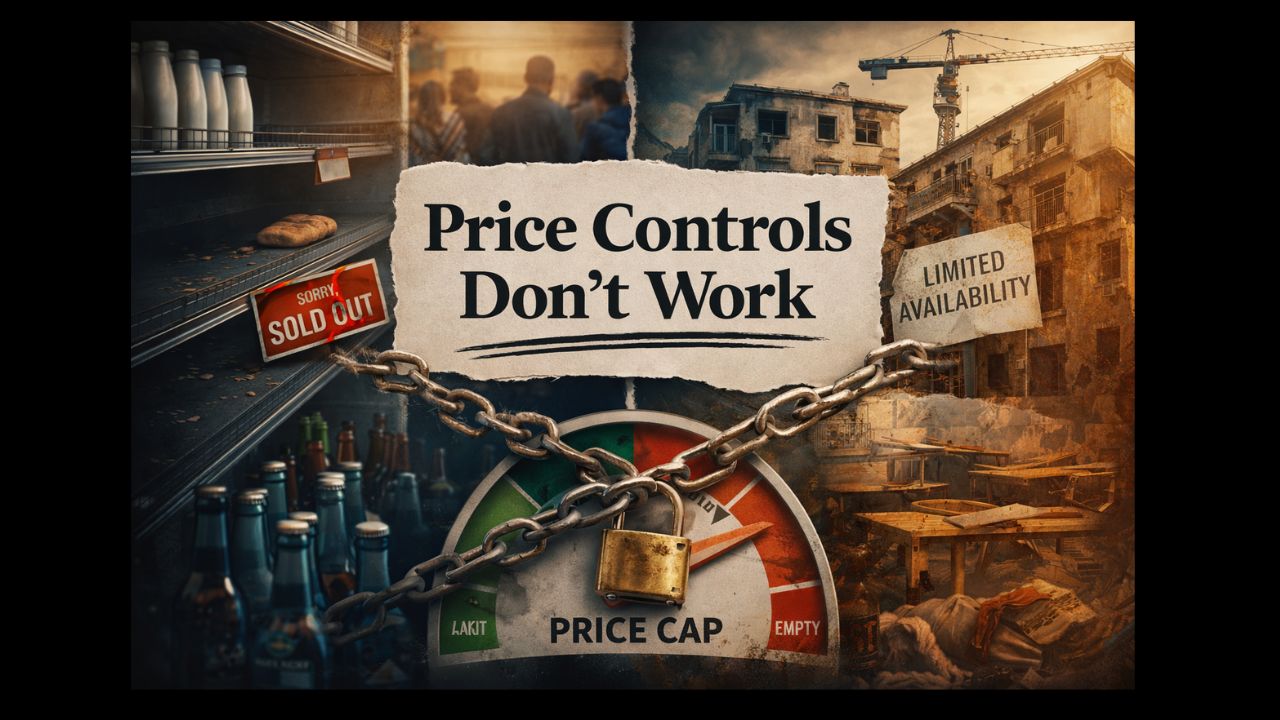
In politics, few ideas are as durable and as consistently disappointing as price controls. When the cost of something rises quickly—whether it is rent, credit, or prescription drugs—the political temptation is obvious: cap the price. The pitch is simple and emotionally compelling. If something costs too much, the government should implement arbitrary price controls to force prices down.
Recent polling from The James Madison Institute shows why these ideas might be resurfacing. Approximately two-thirds of registered voters polled suggested they would be in favor of government price controls on some products and services, with only one in five outright opposed. More than one-third of respondents view price controls favorably depending on the product or service, which reflects their misconception that price controls work and that they will benefit from them being imposed.
Price controls are not a modern invention. They have been tried under Roman emperors, French revolutionaries, Nixon-era economists, Venezuelan technocrats, and New York City planners. In nearly every case, the outcome followed the same arc: initial relief for the people lucky enough to get the controlled good, followed by shortages, deteriorating quality, and reduced investment.
The problem is that economics does not bend to political messaging. Price controls rarely solve the underlying problem. They hide it, defer it, and eventually shift the resulting costs and consequences elsewhere in the market. And more often than not, they make the situation worse.
Across the country, policymakers in both parties have begun embracing some form of price control. Federal proposals to cap credit card interest rates have gained populist traction. Rent control proposals continue to resurface in high-cost cities. Drug price caps are regularly framed as the only way to restrain pharmaceutical costs. Each proposal is presented as targeted relief for households struggling with rising expenses.

Yet the basic dynamic is the same in each case: when government suppresses prices below market levels, supply shrinks, investment declines, and access becomes more limited.
Rent control offers the clearest historical lesson. Decades of economic research have shown that strict rent controls reduce housing supply and quality over time. Property owners convert rental units into other uses, reduce maintenance, or abandon development plans altogether. The result is patently predictable—fewer homes available to rent, deteriorating housing stock, and higher prices for the units that remain outside the controls. Even economists sympathetic to affordability concerns generally acknowledge that rent control addresses the symptom while deepening the shortage.
Credit markets operate under similar constraints. Proposals to cap credit card interest rates, often arbitrarily around ten percent, may sound appealing in a vacuum. But risk does not disappear simply because policymakers decree a lower price. Lenders respond by tightening access to credit, particularly for borrowers with weaker credit histories, who ironically may need it most. For households already on the financial margin, the practical outcome can be fewer borrowing options, lower credit limits, or complete exclusion from the market.
Drug pricing follows the same pattern. Pharmaceutical development is among the most capital-intensive and risky forms of innovation in the economy. When the government imposes aggressive price controls, the long-run effect is reduced investment in research and development. The Congressional Budget Office has repeatedly warned that strict price caps could reduce the number of new medicines entering the market over time. Patients may see lower prices in the short term, but will likely see fewer treatment options in the future.
These are not theoretical concerns; they reflect how markets respond when the incentives that support supply and innovation are weakened or dismantled.
Florida offers a useful contrast to the growing national enthusiasm for intervention. The state has experienced one of the strongest economic expansions in the country over the past several years. Population growth, job creation, and business formation have all outpaced national averages. While Florida certainly faces affordability challenges, its overall policy approach has leaned toward expanding supply and reducing regulatory barriers rather than imposing price ceilings.
Housing policy illustrates the difference. Instead of rent control, recent reforms have focused on encouraging construction and removing local barriers to new housing types. Efforts to expand accessory dwelling units and other forms of incremental housing supply recognize a basic reality: the only durable way to reduce housing costs is to increase the number of homes.
The same principle applies more broadly across the economy. When markets are allowed to function, higher prices signal scarcity. Those signals attract new investment and new entrants, eventually increasing supply and stabilizing costs. Price controls interrupt that process. They mute the signal without solving the shortage.
That does not mean policymakers should ignore affordability concerns. Rising housing costs, medical expenses, and consumer debt are real pressures for many families. But durable solutions tend to focus on expanding supply, increasing competition, and removing policy barriers that artificially restrict markets.
In housing, that means allowing more homes to be built. In healthcare, it means encouraging competition, expediting drug approvals, and reducing regulatory obstacles that increase costs. In financial services, it means fostering innovation and competition rather than limiting lenders’ ability to price credit according to risk.
Price controls persist as a political phenomenon not because they work, but because they are easily comprehensible. The connection between a government cap and a lower price is intuitive. The connection between a cap, reduced supply, deteriorating quality, and higher eventual costs requires several steps of reasoning that do not fit on a yard sign. Politicians who propose controls receive credit for the visible benefits and rarely face accountability for the delayed and less visible harms.
The challenge facing policymakers is not simply to make prices look lower in the short run. It is to ensure that the goods and services people need remain abundant, accessible, and innovative over time. Price controls may satisfy a political impulse, but they rarely achieve the larger, more critical goals of long-term supply, affordability, and market growth.
Doug Wheeler is the Director of the George Gibbs Center for Economic Prosperity at The James Madison Institute.