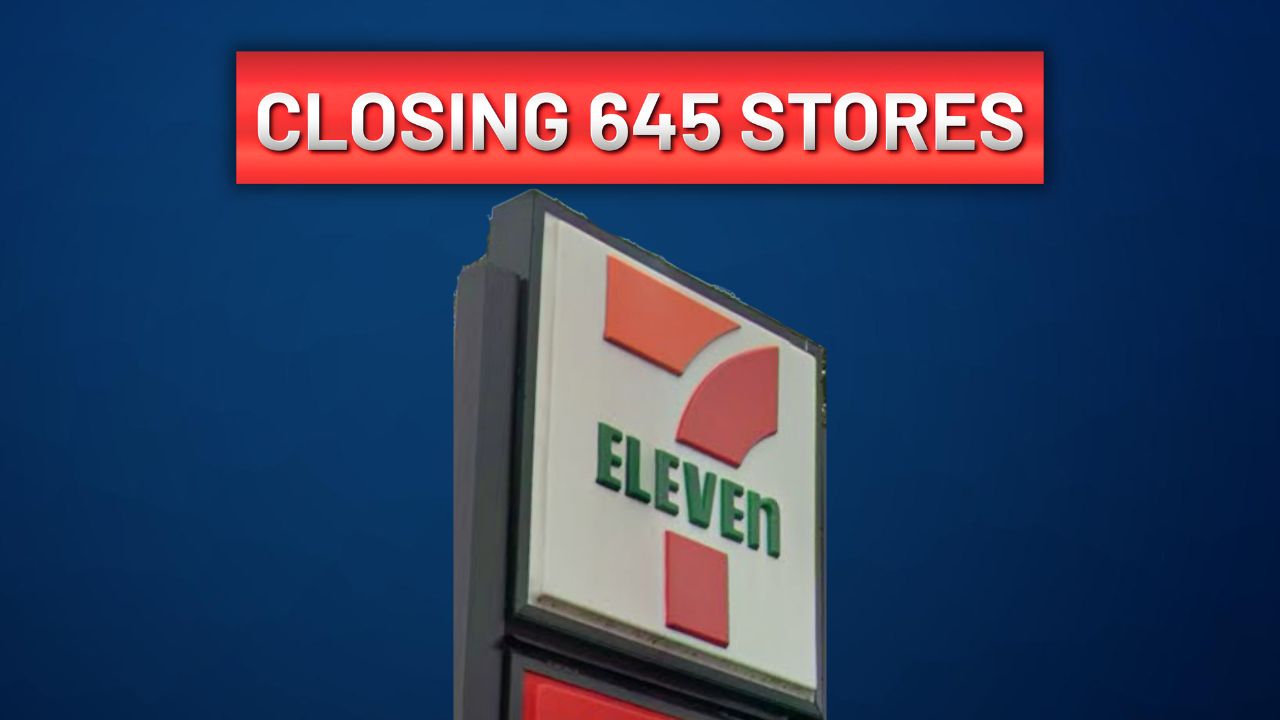
Convenience store giant 7-Eleven is planning a major downsizing across North America, closing hundreds of locations as it works to overhaul its business and prepare for a long-awaited public offering.
According to a recent investor filing from parent company Seven & i Holdings, the company intends to close approximately 645 stores across the United States, Canada, and Mexico during its current fiscal year, which began March 1.
Some of the locations will not disappear entirely. Instead, the company says certain stores may be converted into wholesale fuel outlets, signaling a shift toward lower-cost, fuel-focused operations in underperforming markets.
Fewer Stores, Bigger Strategy
Despite the large-scale closures, 7-Eleven is not pulling back entirely. The company also plans to open roughly 200 new stores across North America this year.
These new locations will reflect a dramatically different vision—larger, modernized stores centered around a “food-forward” concept aimed at competing more directly with fast-casual restaurants and premium convenience chains.

The shift comes after the company acknowledged ongoing challenges with its food offerings. In prior disclosures, 7-Eleven identified negative consumer perceptions around fresh food as a key weakness and said it would invest in upgraded kitchens, new equipment, and redesigned layouts to create a more “distinctive” in-store experience.


IPO Delayed as Company Restructures
The sweeping changes come as Seven & i Holdings prepares for a planned 2027 IPO of its North American business. The offering had originally been targeted for 2026 but was delayed as the company works to cut costs and improve performance.
Closing weaker stores while investing in higher-performing formats is widely seen as part of that strategy—streamlining operations to make the business more attractive to investors.
Florida Could See Both Closures and Growth
The company has not released a list of specific store closures, but Florida—one of 7-Eleven’s largest U.S. markets—is likely to feel the impact.

At the same time, the state’s rapid population growth and heavy commuter traffic make it a prime target for the company’s new, larger-format stores. That means Florida could see a dual effect: legacy locations closing while newer, upgraded stores open nearby.
Competitors Expanding as 7-Eleven Contracts
While 7-Eleven retrenches, several of its biggest competitors are doing the opposite—expanding rapidly and gaining ground, especially in Florida and across the Southeast.
Wawa has been aggressively building new locations throughout Florida, capitalizing on strong demand for made-to-order food, premium coffee, and spacious, modern stores. The chain has developed a loyal following and continues to grow its footprint in key suburban and high-traffic areas.
Sheetz is also expanding beyond its traditional Mid-Atlantic base, bringing its tech-driven ordering systems and highly customizable food offerings into new southern markets—directly competing for the same younger, on-the-go customers.
Meanwhile, Buc-ee‘s has emerged as a major disruptor with its massive travel centers, extensive food selections, and destination-style retail experience. Its continued expansion across the South has raised the bar for what consumers expect from a convenience stop.
The contrast is stark: while competitors invest in larger stores, better food, and enhanced customer experiences, 7-Eleven is being forced to close underperforming locations as it races to reinvent itself.
Industry at a Turning Point
The convenience store industry is undergoing a fundamental shift. Fuel sales alone are no longer enough to drive growth, and chains are increasingly competing on food quality, store experience, and brand loyalty.
For 7-Eleven, the next two years will be critical. Its ability to successfully transition from a traditional convenience model to a modern, food-driven retail experience may determine whether its planned IPO succeeds—or struggles in an increasingly competitive market.