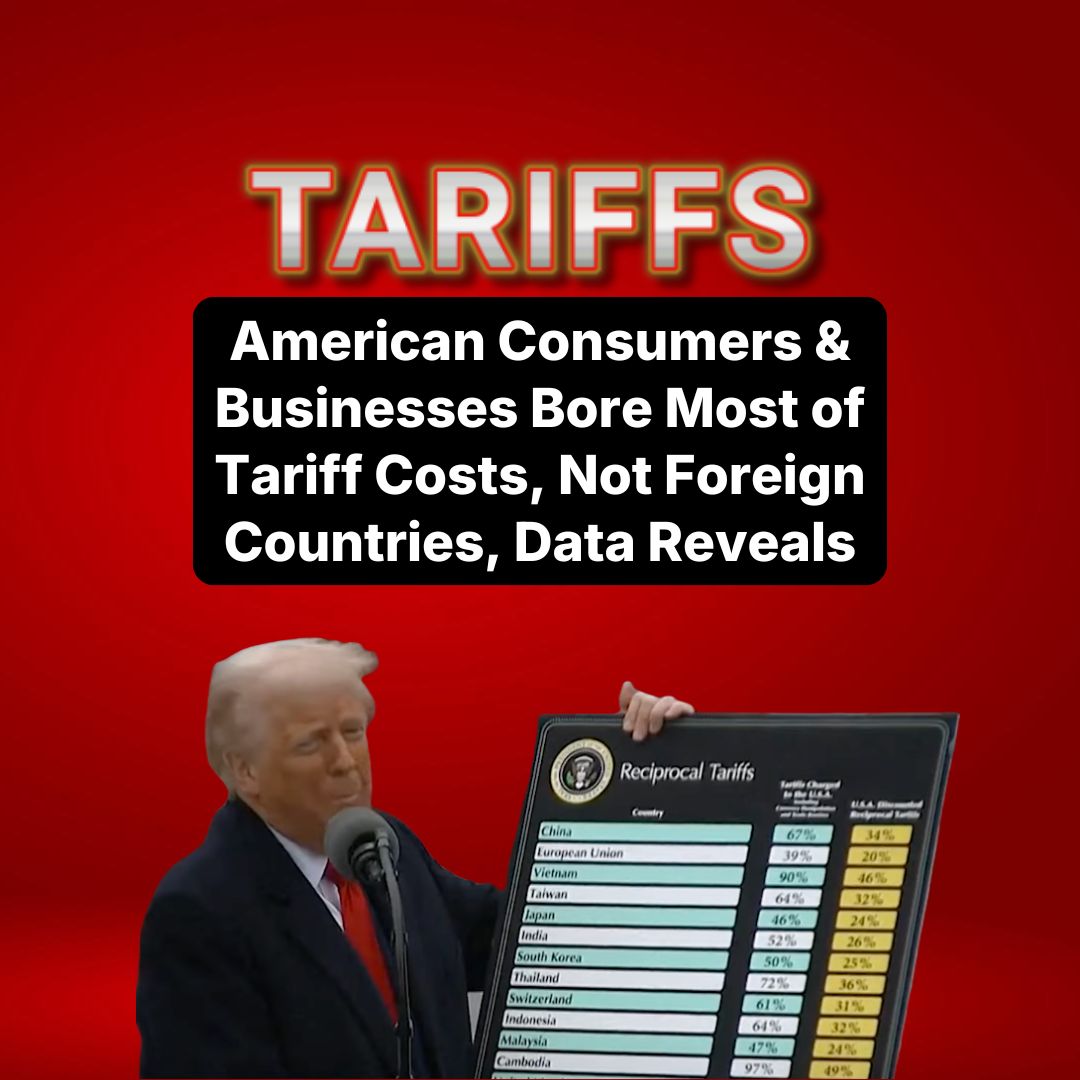
New economic data reports revealed that American consumers and businesses bore the overwhelming share of costs associated with U.S. tariffs imposed in 2025, challenging President Trump‘s assertion that foreign exporters primarily bore the burden.
According to the report, the average U.S. tariff on imported goods climbed to roughly 13% in 2025—up sharply from less than 3% previously. Researchers concluded that nearly 90% of the overall economic burden from those tariffs ultimately fell on U.S. firms and households rather than overseas producers.
The findings show that from January through August, U.S. importers absorbed about 94% of tariff costs. While exporters carried a slightly larger portion later in the year, Americans still shouldered most of the impact, accounting for roughly 92% in September and October and about 86% by November. Similar conclusions were cited in additional federal analysis, which noted that higher tariffs tend to raise the cost of imported goods and, in turn, increase prices paid by U.S. consumers and businesses.
Multiple analyses summarized by economists show that most tariff costs fall on U.S. importers and consumers, with foreign exporters absorbing only a small share.
Separate research cited by fiscal analysts found:
94% of tariff costs paid by U.S. importers early in 2025, still 86% by November.


Policy analysis also notes tariffs are taxes on imports that raise prices and reduce available goods for U.S. businesses and consumers, reinforcing the domestic-cost mechanism
Tax Foundation (A fiscally conservative org): “The Trump tariffs amount to an average tax increase per US household of $1,000 in 2025 and $1,300 in 2026.”
Cato Institute (A fiscally conservative org): “The tariffs behave like a tax on American households. U.S. consumers and firms absorb higher prices and lower income. Domestic GDP and purchasing power decline rather than shifting costs abroad.”
Kiel Institute: Americans paid ~96% of tariff costs.
Congressional Budget Office projections: Consumers ultimately bear the full cost through higher prices.
Studies cited by CATO, an organization devoted to fiscally conservative policy, found that tariffs on Chinese goods cost the average American household roughly $830 per year. Other estimates indicated costs could be significantly higher, with some projections reaching over $1,000 to $2,600 per year per household.
A national Cato survey found 75% of Americans worry tariffs raise consumer prices, reinforcing the conclusion that the perceived burden is domestic rather than foreign.
Consumer Costs and Inflation: Tariffs have led to higher prices on a wide range of products—including automobiles, consumer electronics, and building materials—forcing consumers to bear the brunt through increased retail costs.
Impact on Businesses: American companies, particularly in manufacturing, face higher input costs for materials like steel and aluminum, reducing their competitiveness and forcing them to either pass costs on to consumers or absorb them, which reduces profitability.
- Raise inflation and reduce purchasing power for U.S. households.
- Increase prices for consumer and capital goods.
- Lower GDP and investment over time.
In the short term, the New York Fed estimates that businesses are likely to absorb roughly 30% of tariff-related import price increases through reduced profit margins, while the remaining 70% is typically passed along to consumers through higher retail prices. Overall, the report concludes that domestic firms and households continue to carry the bulk of the financial burden created by elevated tariff levels.